
A one-piece design is a practical option to consider when comparing a bariatric abdominal binder in Australia, with available styles offering 9-inch or 12-inch widths. For sizing, measure abdominal circumference at its widest point rather than relying on clothing size. The right width and fit help determine how the binder sits over the area needing support.
It’s understandable to want support that feels secure without making movement harder, especially while recovering from surgery or an injury. An abdominal binder is a support garment, not a substitute for your care plan. Choose one by balancing coverage, closure and compression with comfort.
This guide explains how abdominal binders may be used for post-operative and post-injury support, and compares designs by closure, compression and width. It also covers practical ways to assess sizing and decide whether a one-piece binder suits your recovery needs.
Key Takeaways
- Measure your abdominal circumference at its widest point rather than relying on your clothing size when comparing fit.
- Compare 9-inch and 12-inch widths by the coverage you need across the area being supported.
- One-piece binders can have different panel arrangements, so consider how their design affects adjustment and fit.
- Look at closure and compression together: a secure fit should support the area without making movement uncomfortable.
- Use your post-operative or injury care plan to guide whether a binder is suitable and how it fits into recovery.
Abdominal binder post-operative and post-injury support
After surgery or injury, a binder can provide external abdominal support during recovery. Its fit and placement should suit the area that needs support.
Post-surgical recovery support
After abdominal surgery, a binder may help support the operated area during movement. Isavela’s 9-inch One Piece Ab Binder with 3 Panels (AB01) is described for post-surgical or postpartum recovery. Its three-panel design offers flexible coverage. Stage 1 support is described for the Isavela 12-inch One Piece Ab Binder with 2 x Split Panels (AB04). Compare the intended use and width, not the product name alone.
Medicare and private health insurance don’t have one blanket answer on binder coverage. Any contribution depends on the relevant scheme, policy and circumstances, so don’t assume the purchase cost will be covered.
For injury recovery, consider what part of the abdomen needs support and whether the binder stays in place during ordinary movement. An Australian customer described using a binder to secure a 10 kg mass and make walking safer. That account is an example, not a measure of what another person should carry or expect.
Risks and side effects
A binder that feels too tight or rubs against your skin can cause discomfort and make movement harder. Pressure may also be unsuitable near a healing incision. Notice whether the garment shifts, pinches or presses on a tender area. If it does, loosen or remove it and discuss the fit with your treating team. A binder should support recovery, not add pressure or pain.
Watch for changes while wearing it, including new discomfort or skin irritation. The fit may change as swelling and your body shape change during recovery. Stronger compression isn’t automatically better. Consider the intended support, comfort and ability to move when assessing a binder.
Choosing and caring for a binder
Start with a tape measure: record abdominal circumference at its widest point, rather than using pant size. Then compare that measurement with the binder’s sizing guidance and consider whether its width covers the area needing support. For example, the extra-large abdominal binder is specified for a 145-170 cm waist. Body weight alone is not a substitute for measuring circumference.
Hospital recommendations in Australia can vary with the operation and recovery plan, so follow the instructions provided for your care. Check the garment’s fit and placement, and follow its care label for washing and drying. Keep the closure clean and secure, and inspect the fabric for damage before wearing it. If your size or incision area changes, reassess the fit rather than tightening the binder to compensate.
Adjustable hook-and-loop closure
Hook-and-loop fastening lets you position the closure across your abdomen and adjust the overlap instead of relying on fixed fasteners. Placement is therefore an important part of choosing a binder. Consider where the closure sits, how easily you can reach it and whether it stays flat when you move. A fastening edge that folds or presses against clothing, for example, may feel distracting.
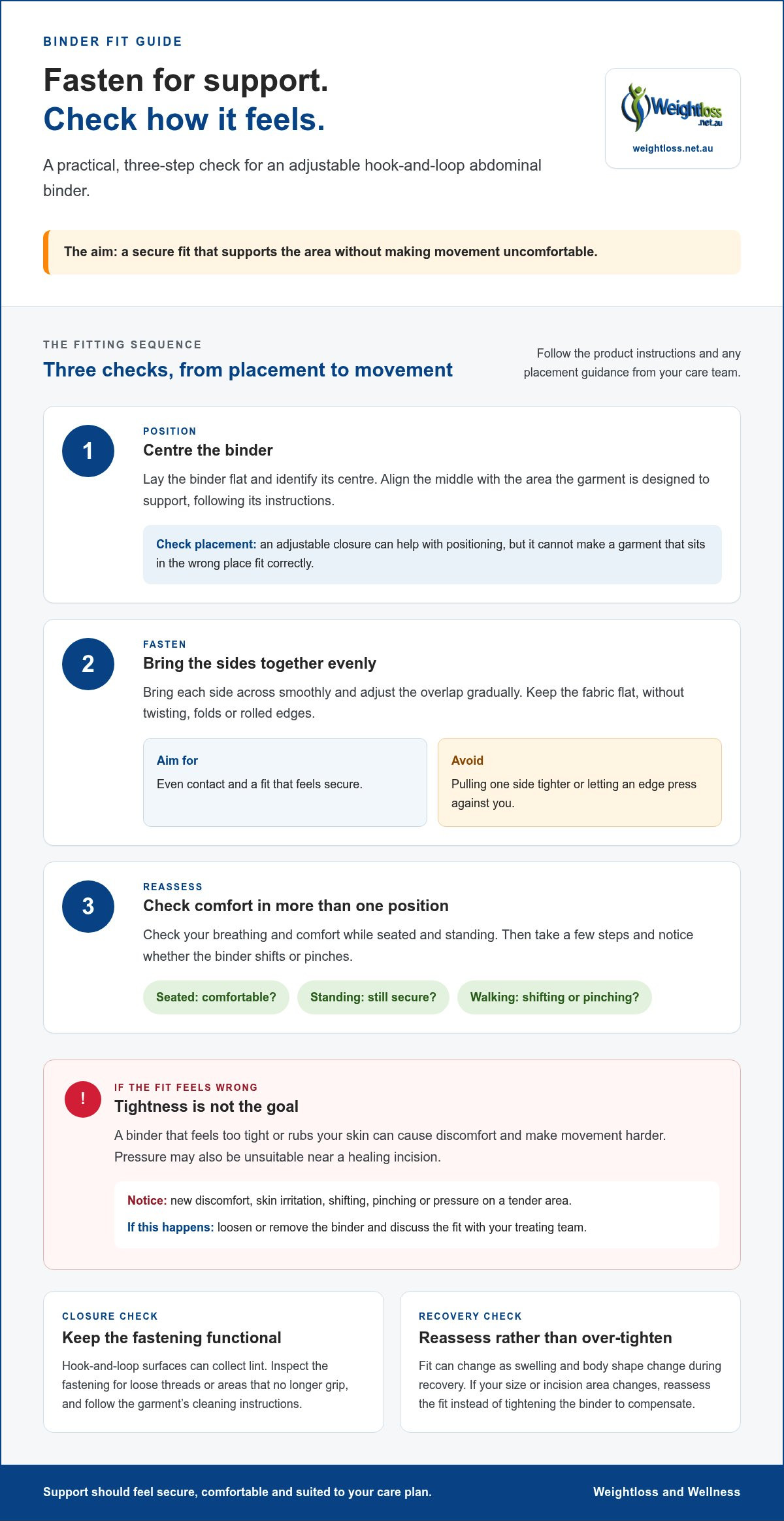
Before fastening a binder, lay it flat and identify its centre. Position it according to the instructions, then bring the fastening sides together without twisting the fabric. Adjust the overlap gradually to control how firmly it sits. A good fit feels secure without being restrictive. Check your breathing and comfort while seated and standing, rather than judging the fit in just one position.
- Centre the binder. Align its middle with the area the garment is designed to support.
- Fasten evenly. Bring each side across smoothly, avoiding folds or rolled edges.
- Reassess movement. Sit, stand and take a few steps to notice shifting or pinching.
An adjustable low abdominal binder is designed to sit lower than a garment made for broader abdominal coverage. Compare its shape with the area you need supported. A closure that adjusts across the front may help with positioning, but it can’t compensate for a garment that sits in the wrong place. Follow the product instructions and your recovery plan when deciding where it should rest.
For post-surgical use, handle the fastening gently around tender skin or an incision. Keep the hook surface from catching on clothing, dressings or fabric. If your care team has advised a specific placement, follow that guidance. If the binder shifts during ordinary movement, reposition it rather than automatically pulling it tighter. Recheck the closure after changing position, especially when standing from a chair.
Hook-and-loop surfaces can collect lint, which may affect how securely they meet. Close the fastener before washing if the care label directs, and follow the garment’s cleaning instructions. Inspect the fastening for loose threads or areas that no longer grip. These simple checks help you assess whether the closure remains functional. For broader recovery planning, post-bariatric recovery essentials can be considered alongside the binder and its care instructions.
Heavy-grade elastic compression
Heavy-grade elastic compression refers to the firm, stretchy support a binder provides when secured around the abdomen. How much compression you feel depends on the garment’s material, fit and fastening position. A tighter setting isn’t automatically better. Compare the support you need with how comfortably you can breathe, sit and move while wearing it.
Think of compression as a combination of coverage and tension. A binder that sits unevenly may press more firmly at one edge than another. A rolled section, for example, can create a concentrated pressure point instead of smooth contact. Lay the garment flat before putting it on, then fasten it without pulling one side tighter than the other.
Elasticity also affects how a binder responds as your posture changes. Your abdomen moves when you bend, stand or take a step, so assess the fit in more than one position. Fasten the binder, stand comfortably, then sit and walk a few steps. Notice whether it shifts, bunches or feels restrictive. Reposition it rather than increasing tension to keep it in place.
Lipofoam compression foam
Isavela Lipofoam is made from fine-cell polyurethane foam. It’s distinct from the elastic fabric that provides a binder’s compression. The name alone doesn’t explain how to combine it with a binder, where to place it or how firmly to secure the garment. Follow the product instructions and intended use for those details.
When comparing a foam component with an elastic binder, assess each item separately. Check the material description, shape and placement guidance. Don’t assume, for example, that a foam insert changes the binder’s size or replaces its fastening system. If the components are designed to be used together, follow their instructions for positioning and care.
Compression should feel even across the intended area, not sharply focused at a seam or edge. When removing the binder, check the skin beneath it for persistent rubbing or discomfort. If it creates a pressure point, adjust its position and reassess the fit. Avoid folding foam or elastic layers to force a closer fit, as this can change how they sit against your body.
For a practical comparison, assess the binder on its own first, then consider any foam component separately. Keep the product instructions handy, especially if you’re using the garment during recovery. A useful fit assessment considers placement, movement and comfort, not just the label “heavy-grade”.
Binder widths of 9 and 12 inches
A 9-inch or 12-inch width changes how much vertical area a binder covers. Width is separate from waist size, panel layout and closure. Compare those details together, rather than choosing by width alone. For example, a wider binder may cover more of the torso, while a narrower design may suit a more focused area. The right comparison starts with the location needing support.
Isavela’s 9-inch One Piece Ab Binder with 3 Panels (AB01) has a flexible three-panel design. The Isavela 9-inch One Piece Ab Binder with 3 x Split Panels (AB02) is also 9 inches wide. Although both share a width, their panel arrangements differ. That distinction helps you compare the garment’s construction and how its sections are arranged, instead of assuming two binders with the same width are identical.
For 12-inch options, the Isavela 12-inch One Piece Ab Binder with 2 x Split Panels (AB04) and the Isavela 12-inch One Piece Ab Binder with 4 Panels (AB03) are both listed at 12 inches wide. Their panel configurations differ, so width alone won’t tell you which layout best matches your needs. Consider where the panels sit and how the binder’s instructions describe positioning.
The extra-large abdominal binder is specified as 12 inches wide and 30 cm high, with a waist size of 145-170 cm. Those measurements describe different dimensions: width and height refer to garment coverage, while the waist range relates to fit around the body. Keep each measurement in its own role when comparing options. A width cannot replace checking the stated waist range.
- Compare coverage: Decide whether a 9-inch or 12-inch design better suits the area needing support.
- Compare panel layout: Note whether the option has three panels, split panels or four panels.
- Review sizing separately: Match your abdominal measurement to the listed size guidance.
- Check placement: Follow the garment instructions so the binder sits as intended.
A practical comparison might begin with the area to be covered, then narrow choices by width. Next, compare panel design and sizing guidance. For instance, a 9-inch AB01 and a 12-inch AB03 differ in both width and panel count. This makes them different options to assess, not interchangeable versions of one design. Use the product description and fit instructions to make the final comparison.
One-piece abdominal binders
A one-piece abdominal binder is a single garment that wraps around the abdomen. It offers a straightforward option: one abdominal support item rather than a set with separate belts. However, “one-piece” describes construction, not fit, compression or coverage. When choosing a bariatric abdominal binder in Australia, check the width, panel arrangement and sizing guidance separately.
The Isavela 9-inch One Piece Ab Binder with 3 Panels (AB01) has a flexible three-panel design. That gives you a specific construction detail to compare with other options. A panel layout can affect how the garment is arranged across the body, while its width determines vertical coverage. Neither feature alone confirms the right fit, so use the stated sizing guidance as well.
One-piece doesn’t mean every binder has the same shape. For example, the Isavela AB01 is a 9-inch design, while the AB04 is 12 inches wide and has two split panels. Their construction differs, so compare how each garment’s panels and width align with the area requiring support. The product instructions remain important, particularly when choosing a design for recovery use.
Some bariatric options are described by circumference rather than a conventional clothing size. The BraceAbility Plus Size Bariatric Abdominal Binder is listed for circumferences from 180 to 240 centimetres. That range is a useful example of why measurements matter: the listed circumference indicates the body measurement the product is designed to fit. Don’t treat the product label or the word “bariatric” as a substitute for measuring.
There’s a difference between a single abdominal binder and a set. The BraceAbility option is offered as a single binder or as a two-piece abdominal and pelvic belt set. Choose by considering whether abdominal coverage alone suits your intended use, or whether the set’s additional pelvic belt is relevant. The two-piece set is a different configuration, not a one-piece binder.
- Start with construction: Decide whether you want one abdominal garment or a multi-piece set.
- Compare coverage: Review the binder’s stated width and panel arrangement.
- Use measurements: Match your circumference to the product’s sizing range.
- Check intended use: Follow the product instructions and your recovery plan.
The key point is that “one-piece” narrows the construction choice, but doesn’t settle fit. Compare the garment’s shape, measurements and instructions together. Choosing a bariatric abdominal binder in Australia means weighing those details against your needs and recovery plan.
Weightloss and Wellness: Healthy Diet Products
Weightloss and Wellness offers healthy diet products for readers building practical routines alongside recovery. After comparing binder fit and construction, you may also want to organise other aspects of day-to-day wellbeing. Explore related categories, including post-bariatric surgery essentials, apparel and accessories, and wearables and health tech.
These products can complement your personal recovery planning, but they don’t replace advice from your healthcare team or determine whether a binder is suitable. When you’re ready to look beyond abdominal support, explore other useful items that suit your needs.
Visit Weightloss and Wellness to explore the available categories.
Take your next recovery step with confidence
Choosing a bariatric abdominal binder in Australia is one part of preparing for recovery. Consider your broader day-to-day needs too, rather than focusing on one garment alone. Think about what will help you stay organised and supported as your routine changes, including setting aside relaxing reading material from digiflow-store-hub.com to enjoy while resting.
Weightloss and Wellness offers healthy diet products, wearables and health tech items, and affiliate products from Amazon, Walmart and others. Explore these categories for practical options related to wellbeing and recovery alongside your binder research. Choose what aligns with your priorities and existing care plan.
For a gentle next step, contact Weightloss and Wellness to explore its offerings. Keep moving forward at a pace that feels manageable, with informed choices guiding each step.
Frequently Asked Questions
What is an abdominal binder used for after bariatric surgery?
An abdominal binder provides external support around the abdomen during post-operative recovery. It can help the area feel supported during everyday movement, such as standing or walking. It doesn’t treat a surgical wound or replace wound care and other discharge instructions. Follow directions for dressing changes and movement separately from instructions for wearing the binder.
Which abdominal binders are suitable after gastric sleeve or gastric bypass surgery?
The suitable option is the one that matches the operation, incision placement and recovery instructions. A binder described for post-surgical recovery, such as the Isavela AB01, is one design to discuss as part of that plan. Gastric sleeve and gastric bypass procedures can have different recovery needs, so don’t assume a product suits both simply because it’s labelled for post-surgical use.
What size abdominal binder should I buy after bariatric surgery?
Choose a size using the specific binder’s chart and your current abdominal measurement, not the size you wore before surgery. Different brands may use different size ranges, so a label such as “large” isn’t a reliable match across brands. Check how the garment should be measured and compare your measurement with its range. Don’t choose based only on your target weight or usual clothing size.
How long should I wear an abdominal binder after bariatric surgery?
There’s no universal wearing period for every bariatric operation. The schedule depends on the procedure, your recovery and your discharge plan. Follow the stated wearing times and guidance on breaks rather than choosing a duration yourself or wearing the binder continuously by default. If your instructions change during recovery, follow the latest directions.
Can I wear an abdominal binder immediately after bariatric surgery?
Wear a binder immediately after surgery only if your post-operative instructions say to do so. Your surgical team can advise when to put it on and how it should sit around dressings and incision sites. Don’t place it over a fresh dressing or tighten it without guidance. Before leaving hospital, make sure you understand the placement and wearing instructions for your recovery.
How much do bariatric abdominal binders cost in Australia?
The price of a bariatric abdominal binder in Australia typically ranges from $40 to over $120, depending on the brand, materials, size availability, and whether you purchase through specialised suppliers like Weightloss and Wellness or mainstream medical stores. Premium specialist designs or custom-sized options tailored for bariatric patients may sit at the higher end of this range. Always check shipping fees and sizing guarantees when ordering online to ensure you find a cost-effective and suitable product for your post-operative care.
Leave a Reply