
A calorie deficit doesn’t require extreme restriction. It means taking in fewer calories than your body uses, and understanding how to create a calorie deficit starts with finding a manageable way to do that. A daily deficit of around 300 to 500 calories is a commonly recommended range for healthy weight loss, with a healthy rate often described as about half to one kilogram per week.
If counting calories or changing your routine feels daunting, you can create a calorie deficit by adjusting what you eat, moving more, or combining both. The most practical approach is one you can maintain while eating nourishing foods and caring for your wellbeing.
This article explains how a calorie deficit works and how food choices, everyday movement and exercise can help you create one. You’ll also learn why a steady, flexible approach is more practical than severe restriction.
Key Takeaways
- Learn how changing food intake, increasing movement or combining both can help shift your energy balance.
- Explore practical ways to choose filling foods with protein and fibre while making room for lasting habits.
- Spot calorie-dense, lower-nutrition options that could be swapped for choices that better support your goals.
- Understand why a personalised, sustainable approach is more sensible than skipping meals or cutting out whole food groups.
What Is a Calorie Deficit?
A calorie deficit means consuming fewer calories than your body uses. To track food and drinks accurately, check labels, measure portions, and record ingredients and beverages consistently.
Energy balance and weight loss
Energy balance compares calories consumed with the energy your body uses. When intake remains below that use, your body draws on stored energy, including body fat, and weight loss can follow over time. The deficit matters because it explains why food choices and activity both affect your weight. A weekly pattern is more informative than one meal or one day.
Eating less and exercising more
Eating less, moving more, or combining both can create a calorie deficit. For example, you could reduce a portion at one meal and add a walk to your routine. The aim isn’t to cut out nourishing foods: vegetables and protein can help make meals satisfying. Consult your doctor before beginning a weight-loss program, and ask for advice suited to your health and circumstances.
Weight-loss pace and individual variation
A commonly cited healthy pace is around half to one kilogram per week. A daily deficit of about 500 calories is a rule of thumb, not a precise forecast. The old estimate that 3,500 calories equals a pound of fat doesn’t predict everyone’s results accurately, especially over time. Starting weight, food intake, activity and other individual factors can affect how quickly you lose weight. Progress may vary from week to week.
Changing energy needs
As your weight changes, the energy your body uses can change too. A calorie target that once created a deficit may have a different effect later. If weight loss slows, review your recent food and activity patterns rather than making a drastic cut. Consistent tracking can help you notice shifts in portions or movement. Over time, consuming more energy than your body uses can lead to weight gain, and the balance can shift again as your habits and needs change.
Reducing calories and increasing physical activity
A calorie deficit can come from eating less, moving more, or combining both. Estimating your energy needs can help you make these changes thoughtfully.
Combining healthy eating with activity
Pairing balanced eating with physical activity can reduce your intake while increasing energy use, giving you more than one way to adjust your routine. For example, include vegetables and protein in meals and add a walk to your day. The goal isn’t simply to consume fewer calories, but to find changes that support a healthy pattern you can maintain.
Physical activity and strength training
Physical activity uses energy, while strength training adds a structured form of movement to your week. The University Hospitals guide recommends planning strength training at least twice a week. It also notes that exercise alone is usually not enough to create a calorie deficit. Combining activity with changes to food intake can help you manage your overall calorie balance.
Estimating needs with BMR and activity levels
Basal metabolic rate (BMR) estimates the energy your body needs for basic functions at rest. The Mifflin-St Jeor equation estimates BMR, then an activity multiplier helps estimate daily energy needs. University Hospitals gives multipliers of 1.2 for sedentary activity, 1.375 for light activity, 1.55 for moderate activity, 1.725 for very active, and 1.9 for extra active. These are estimates, not measurements of every movement or breath.
Increasing physical activity
Build movement into activities you already do, then increase it in a way that suits your routine. The American Institute for Cancer Research suggests adults do at least 150 minutes of moderate exercise or 75 minutes of high-intensity exercise each week. Shorter bouts can also count: the University Hospitals guide suggests fitting exercise into 10-minute spurts. A wearable may help you record activity, while healthy diet products can complement food choices.
Cutting high-calorie, low-nutrition foods
Swapping some energy-dense choices can reduce your intake while leaving room for nourishing foods. Focus on balanced portions rather than eating as little as possible.
Choosing nutrient-rich foods
Nutrient-rich foods provide nourishment alongside calories, helping make a reduced-energy diet more balanced. Vegetables, fruits, and foods containing protein and fibre can help meals feel satisfying while you eat fewer calories.
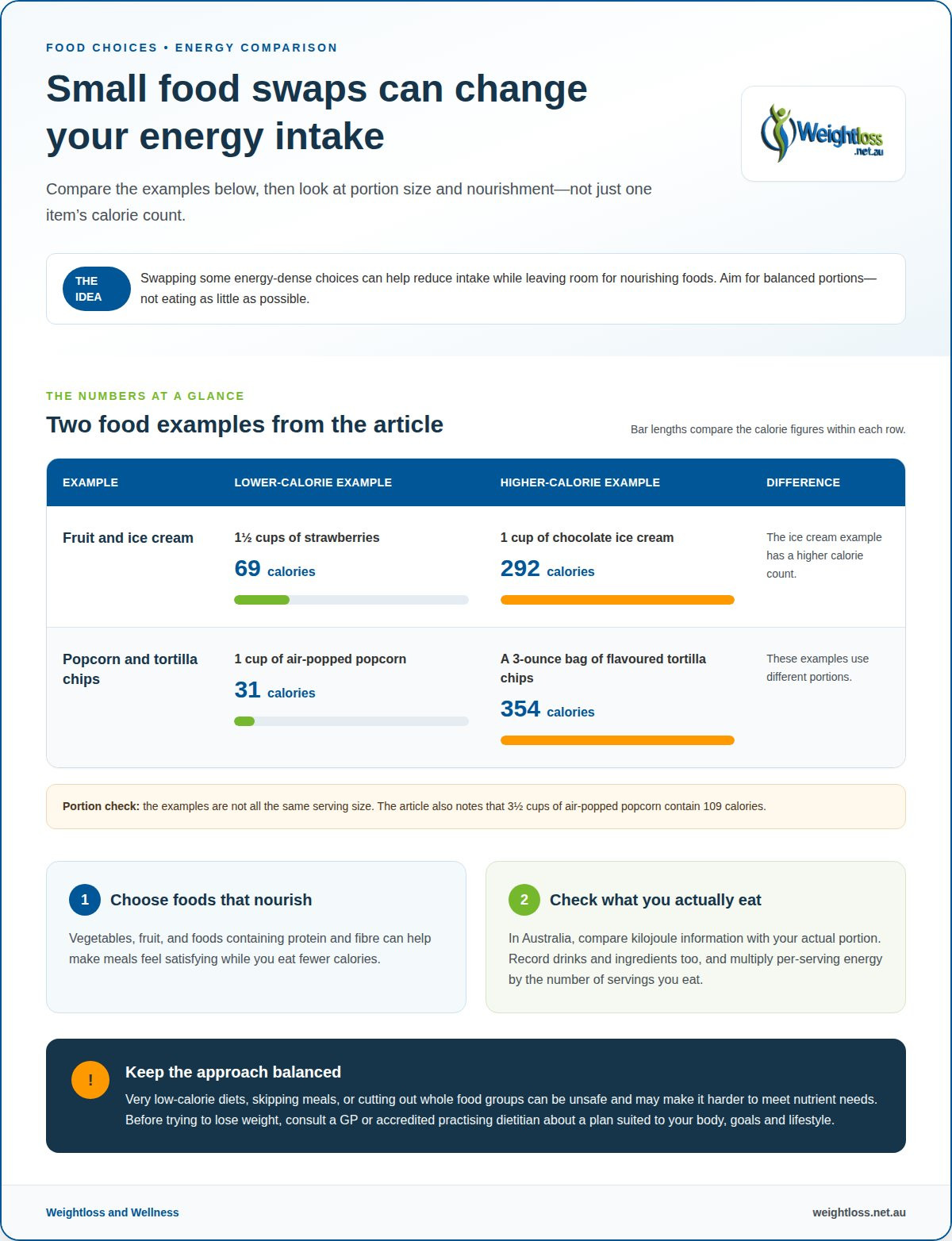
For example, 1½ cups of strawberries contain 69 calories, while a cup of chocolate ice cream contains 292 calories. Air-popped popcorn is another option: 3½ cups contain 109 calories. These examples show how food choice and portion size can affect intake.
Very low-calorie diets, skipping meals, or cutting out whole food groups can be unsafe and may make it harder to meet nutrient needs. Before trying to lose weight, consult a GP or accredited practising dietitian to tailor a plan to your body, goals and lifestyle.
Food labels and kilojoule counting
Food labels and portion sizes help you estimate what you consume. In Australia, compare the kilojoule information with the amount you actually eat, rather than assuming the stated serving matches your portion. Record drinks and ingredients too, as they contribute to your total intake.
For more accurate calorie tracking, measure portions and use the label’s serving information consistently. If a product has several servings, multiply its per-serving energy by the number you eat. Keep units consistent when logging, especially if your tracker displays calories while the label displays kilojoules.
Small swaps can add up across meals. A cup of air-popped popcorn contains 31 calories, while a 3-ounce bag of flavoured tortilla chips contains 354 calories. Consider your activity level and overall nutrient intake, not just one item’s energy value.
Creating a calorie deficit
A practical way to understand how to create a calorie deficit is to compare estimated maintenance needs with usual intake. For example, someone needing roughly 2,000 calories daily could aim for 1,500, creating a 500-calorie deficit. This arithmetic illustrates the concept, not a personal prescription. Current weight, health, activity and eating patterns all influence a suitable intake.
A 500-calorie daily deficit is a common rule of thumb, not a promise of a particular result. University Hospitals says a deficit of 500 to 1,000 calories per day helps most people lose about 0.5 to 2 pounds per week. The higher end may not suit everyone. A healthy weight goal should reflect personal circumstances, not just a calculator’s estimate.
You can also combine a food adjustment with more physical activity. University Hospitals gives an example of creating a 500-calorie daily deficit by burning 200 extra calories through exercise and cutting 300 calories from food. This split shows that you don’t need to make the entire change through eating less. The balance depends on your routine and what feels manageable.
Avoid treating a lower intake as the only measure of progress. Very low-calorie diets, skipping meals and cutting out whole food groups can be unsafe. University Hospitals’ dietitian advises following a calorie deficit for 6-12 weeks before increasing calories or returning to maintenance. Use that as context for planning, while keeping nutrition and wellbeing in view.
For a practical starting point on how to create a calorie deficit, consider your usual routine before choosing changes. A GP or accredited practising dietitian can help tailor an approach to your health, goals and lifestyle. For support with everyday food choices, explore healthy diet products alongside balanced meals and regular movement.
Weightloss and Wellness
Weightloss and Wellness offers products that can support a considered approach to weight management, including healthy diet products, wearables and health tech, apparel and accessories, and affiliate products from Amazon, Walmart and other retailers.
These options may help you organise food choices, track activity or find practical items that fit your routine. They don’t replace individual medical advice. For personal health questions, consult your GP or an accredited practising dietitian. Choose practical changes that make everyday habits easier to maintain.
If you’d like to explore relevant options, contact Weightloss and Wellness.
Make your next step sustainable
Understanding how to create a calorie deficit is a starting point, not a demand for perfect tracking or rigid rules. Choose one manageable adjustment that suits your routine, then consider how it fits with meals, movement and everyday life. A steady approach gives you room to adapt as your needs and habits change.
Weight Loss and Wellness offers products that can support your wellness routine, including healthy diet products, wearables and health tech, and affiliate products from Amazon, Walmart and other retailers. These options can complement your choices, but they don’t replace personalised medical advice. If you have health concerns or need help setting a suitable weight goal, consult your GP or an accredited practising dietitian.
Ready to explore practical support for your next step? Reach out to Weightloss and Wellness and take the path forward at a pace that feels right for you.
Frequently Asked Questions
Is it okay to eat less than 1200 calories a day?
Eating below 1200 calories a day may make it difficult to meet your nutritional needs. This figure isn’t a personal target: energy and nutrient requirements vary with factors such as body size, health and activity. Avoid severe restriction or skipping meals to speed up weight loss. Speak with your doctor before starting a weight-loss program, particularly if you’re considering a very low intake.
What is a calorie deficit and how does it lead to weight loss?
A calorie deficit means your food and drink provide less energy than your body uses. Your body can then draw on stored energy, including body fat, and weight may reduce over time. For example, if someone uses about 2,500 calories daily and consumes about 2,000, the difference creates a deficit. That arithmetic is an illustration, not a prediction of an individual’s results.
How do I calculate my daily calorie needs in Australia?
Estimate your basal metabolic rate (BMR), then account for your usual activity to estimate maintenance needs. The Mifflin-St Jeor method uses weight, height, age and sex; according to University Hospitals, a sedentary estimate multiplies BMR by 1.2. Use your measurements in kilograms and centimetres, and treat the result as a starting estimate rather than a precise measurement of daily energy use.
How many calories should I eat to create a safe calorie deficit?
There isn’t one calorie target that suits everyone. A commonly recommended deficit is around 300 to 500 calories daily, but the amount to eat depends on your maintenance needs, health, activity and usual intake. Avoid using a generic target as a strict rule. A GP or accredited practising dietitian can help tailor an approach, especially if you have health concerns or a history of restrictive eating.
What is a healthy rate of weight loss per week?
A commonly cited healthy pace is around half to one kilogram per week. Your progress may differ because energy needs, starting weight, food intake and activity vary between people. Treat this range as general context, not a weekly requirement or a reason to intensify restriction. A doctor or accredited practising dietitian can help set a suitable goal based on your health and circumstances.
How can exercise and daily activity contribute to a calorie deficit?
Exercise and everyday movement use energy, so adding activity can contribute to a deficit alongside food choices. The American Institute for Cancer Research suggests adults do at least 150 minutes of moderate exercise or 75 minutes of high-intensity exercise each week. Choose movement you can fit into your routine, such as walking or cycling, and increase it gradually to support consistency.
This page contains affiliate links. We may earn a small commission at no extra cost to you if you purchase through these links. The information is for reference only, isn’t medical advice, and doesn’t endorse any product. Consult your doctor before starting a weight-loss or wellness program, and read Weight Loss and Wellness’s Terms of Use and Disclaimer for more details.