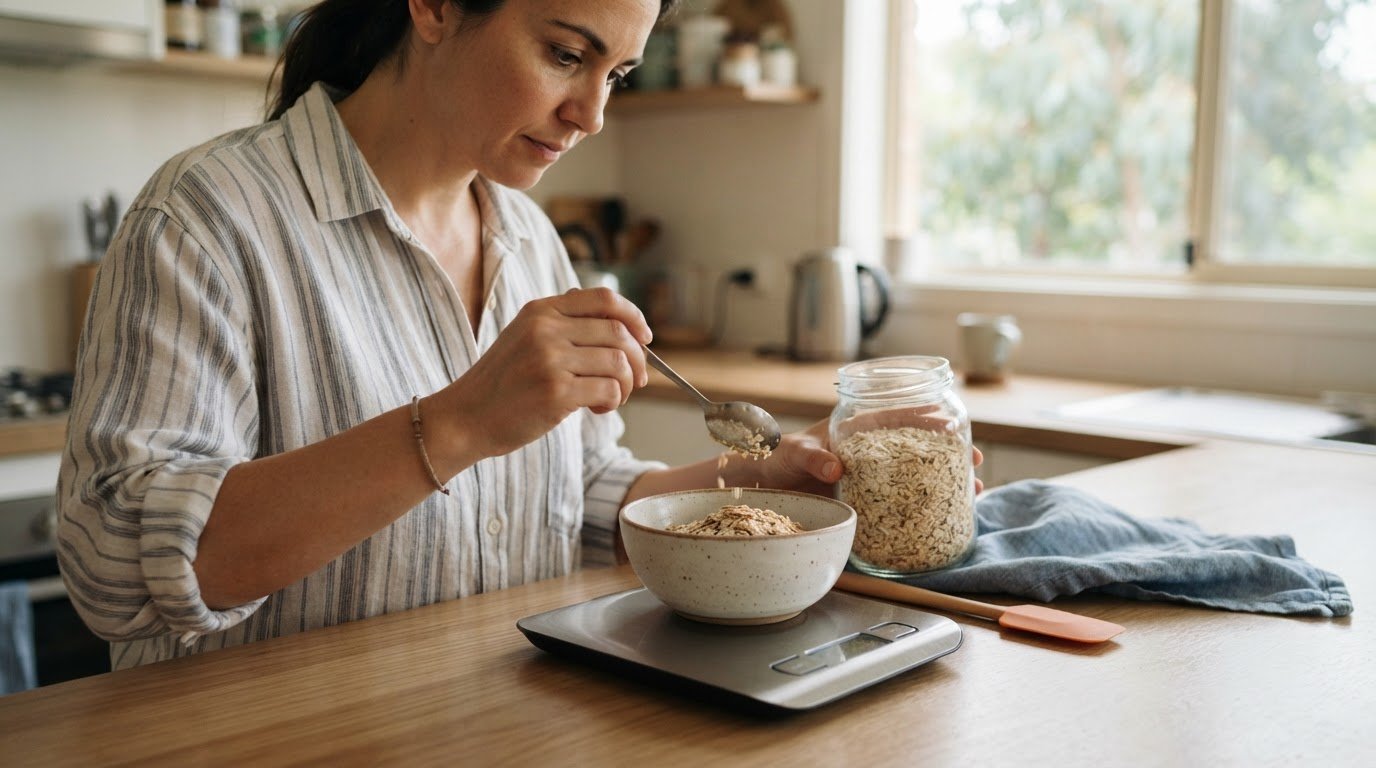
A food scale is a portion-tracking tool, not a weight-loss plan. When choosing a digital food scale for weight loss in Australia, prioritise gram measurements, a tare function and a capacity that suits the foods you prepare. Some kitchen scales measure in 1 g increments, which can help you record ingredients more consistently.
It’s understandable to want a clear way to track portions, especially when serving sizes are hard to estimate by eye. A digital food scale can make weighing ingredients more straightforward, but it works best as one practical part of a sustainable routine, not as a measure of progress on its own.
This guide explains what to compare, from display and weighing units to capacity, cleaning and everyday ease of use. You’ll also learn how to choose a scale that fits your meals and tracking habits, so you can make a considered choice without being distracted by features you may not need.
Key Takeaways
- Choose a scale whose maximum capacity suits the ingredients and containers you usually weigh.
- Compare measurement increments as well as capacity to find a level of precision that fits your portion-tracking habits.
- Consider practical details such as the display, weighing surface and power source before choosing a model.
- Use Australian listings to compare available scale styles, then pick one that fits your kitchen routine and budget.
Kitchen scale buying guides
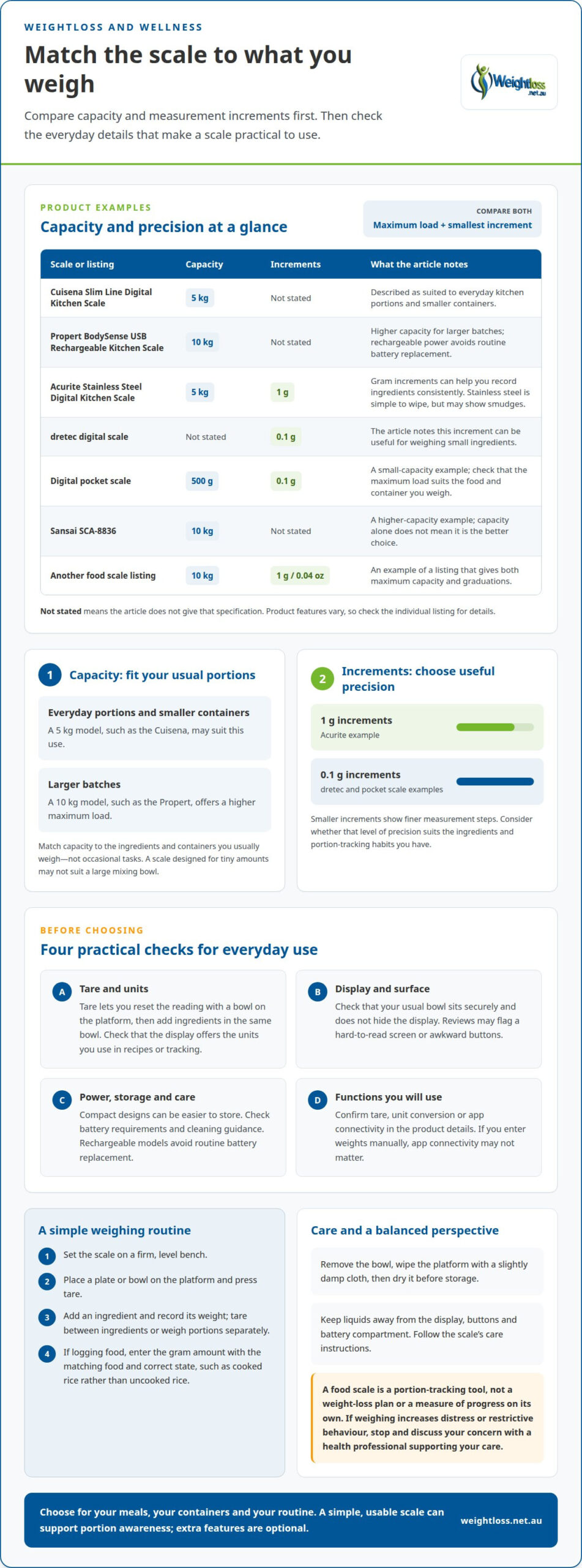
Start with what you weigh most often. A bowl of oats needs different capacity from meal-prep ingredients. The Cuisena Slim Line Digital Kitchen Scale has a 5 kg capacity. That suits everyday kitchen portions and smaller containers. For larger batches, the Propert BodySense USB Rechargeable Kitchen Scale holds 10 kg. Match capacity to your usual ingredients, not occasional tasks. Also consider where the scale will sit. A compact design can be easier to store in a crowded drawer.
Next, compare increments and units. Acurite’s Stainless Steel Digital Kitchen Scale measures in 1 g increments and holds 5 kg. Gram readings can help you record ingredients consistently. Check that the display shows the unit you use in recipes or tracking. A tare function is useful for weighing several ingredients in one bowl. Place the empty bowl on the platform, tare the reading, then add each ingredient. Check the surface size too. A wide plate or mixing bowl should sit securely without hiding the display.
Compact scales save bench and cupboard space, while rechargeable models avoid routine battery replacement; stainless steel can be simple to wipe, but may show smudges. For example, the rechargeable Propert model has a 10 kg capacity, while Acurite’s stainless steel model offers 1 g increments.
To clean a digital kitchen scale, remove the bowl and wipe the platform with a slightly damp cloth, then dry it before storage. Keep liquids away from the display, buttons and battery compartment, and follow the care instructions supplied with the scale.
Weighing food can become stressful if tracking feels rigid or leads to guilt around meals. If using a scale increases distress or restrictive behaviour, stop weighing and discuss your concern with a health professional supporting your care.
Make the scale easy to use consistently. Set it on a firm, level bench before weighing, away from hot appliances and the sink. Store it dry, with nothing pressing on its buttons. If preparing several portions, weigh the ingredients before dividing them and record each amount in the same unit. A simple routine matters more than extra functions. Choose features that suit your meals and leave the rest unused. A scale can support portion awareness, but it cannot assess overall nutrition or replace a balanced eating pattern.
Kitchen scale overview
Digital scales differ in capacity, precision and features. The dretec digital scale measures in 0.1 g increments, useful for weighing small ingredients. Another food scale listing gives 10 kg capacity and 1 g/0.04 oz graduations. A digital pocket scale holds 500 g and measures in 0.1 g increments. These examples show why the maximum load and smallest increment both matter. A scale designed for tiny amounts may not suit a large mixing bowl.
For tare, unit conversion or nutrition-app features, choose a model whose product details explicitly list each function. Capacity and precision alone don’t confirm those features. Reviews can reveal practical issues, such as a hard-to-read screen or awkward buttons. Prioritise comments describing everyday use over ratings without useful detail.
To track portions, place a plate or bowl on the platform and press tare. Add an ingredient and record its weight. Tare between ingredients, or weigh each portion separately. Enter the gram amount alongside the matching food in your calorie-tracking app. Select the correct food state, such as cooked rice rather than uncooked rice. The logged result depends on choosing the right food entry and entering the portion weight accurately.
Compatibility between a smart scale and Australian calorie-tracking apps depends on the scale and app supporting the same connection or integration. Check the app name and device requirements in both product descriptions before relying on automatic syncing. If they don’t share an integration, you can still enter the measured portion manually.
Test a scale on a firm, level bench. Place a familiar item on it, remove the item, then repeat the measurement. Check whether the reading returns to zero and whether the display remains visible beneath your usual bowl. For instance, test the tare button with a mixing bowl, then add ingredients one at a time. These simple checks show whether the controls suit your routine. Explore weight-loss resources alongside practical portion tracking.
How much do digital kitchen scales cost in Australia?
Australian listings vary by model and retailer. Compare the scale’s capacity, increments and construction before weighing its value. A compact kitchen model may suit routine ingredient portions, while a higher-capacity design can handle larger bowls. For example, the Cuisena Slim Line Digital Kitchen Scale has a 5 kg capacity. Capacity alone doesn’t show whether a scale suits your needs. Consider what you’ll weigh, and how often.
Extra functions can affect a scale’s listed price. A tare button helps weigh multiple ingredients in one container. Unit conversion can simplify recipes with different measurements, while rechargeable power may suit someone who prefers not to use disposable batteries. A feature adds value only if it fits your routine. If you enter weights manually, app connectivity may not matter. Compare the functions you’ll use with the scale’s size and storage needs.
Use this simple comparison process before choosing:
- Match capacity to portions. The Sansai SCA-8836 has a 10 kg capacity, while the Cuisena model holds 5 kg.
- Compare precision. Acurite’s Stainless Steel Digital Kitchen Scale measures in 1 g increments.
- Review power and care. Check the product details for battery requirements, cleaning guidance and included accessories.
These examples help explain why prices differ, but a high-capacity scale isn’t automatically the better buy. Materials, display, functions and an included bowl may also affect the listed price. Compare the full product description, not just the headline figure. If two models meet your needs, consider which offers the simpler everyday routine. A clear display and familiar controls may matter more than advanced features you won’t use.
Australian listings can change, so compare each retailer’s current total, including delivery where applicable. Set your priorities first: required capacity, readable units and preferred power source. Then assess each listing against those needs. This keeps the decision focused on practical value rather than features that won’t support your portion tracking.
Which Australian retailers sell digital food scales, and what are their prices?
Australian online listings include several digital kitchen scale models. The research examples include OXO Everyday Glass Food Scale, Taylor Touchless Tare Digital Dual Kitchen Scale and Cuisena 2 in 1 Scale 5kg Silver. Retailer names aren’t provided here, so use each retailer’s search tools to locate these models. Compare the current listing details before deciding. Product names alone don’t show whether a scale suits your portion-tracking routine.
Prices vary across listings and models. Rather than choosing by headline price alone, compare the functions and construction described on each product page. A dual-platform scale, for example, may suit someone weighing separate ingredient amounts. A bowl-style model may be useful for mixing ingredients directly, while a simpler design may suit routine portion weighing. Match the design to your usual meals, then compare equivalent features across listings.
Use this retailer comparison checklist:
- Search the exact model name. This helps distinguish similarly named Taylor or Cuisena scales.
- Compare like with like. Check capacity, measurement increments, tare and unit options.
- Read the listing details. Note the stated power source, included bowl and care instructions.
- Review the checkout total. Include any delivery charge shown by the retailer.
For instance, compare the OXO Everyday Glass Food Scale listing with a Taylor model. Check the features stated for each, then consider how they fit the way you prepare food. A lower listed price may not suit your needs if a key function is missing. Equally, extra features aren’t automatically useful. The best value is the option that supports regular weighing without adding unnecessary complexity.
Retailer listings can change, so treat displayed prices as current only at the time you view them. Before ordering, confirm the selected model, included accessories and delivery details on that listing. If portion tracking is part of a broader health goal, explore weight-loss support products as another practical step alongside choosing kitchen equipment.
Weightloss and Wellness: Products that support medical weight loss
Weightloss and Wellness offers products that support medical weight loss, along with healthy diet products, wearables and health tech, and apparel and accessories. These options can complement practical habits such as portion tracking, but a kitchen scale is only one tool in a broader routine.
Consider these products if you’re looking for practical items to support your existing weight-management approach. Healthy diet products may help with food planning, while wearables and health tech can support personal tracking. Choose items that fit your needs and the guidance you already follow. No single product replaces a sustainable eating pattern or appropriate care.
If you’re exploring products to support your goals, contact Weightloss and Wellness.
Make portion tracking fit your routine
Choose a manageable next step. Before weighing every meal, decide what you want to learn from tracking. You might use a scale to understand familiar portions, plan recipes or make food records more consistent. Keep the process practical, and adjust it if weighing becomes stressful or distracts from enjoying meals.
A digital food scale for weight loss in Australia can support awareness, but it shouldn’t become the measure of your progress. A steady routine also leaves room for flexibility, personal preferences and the guidance you already follow. If you’re considering additional tools, Weightloss and Wellness features affiliate products from Amazon, Walmart and others.
For a considered next step, contact Weightloss and Wellness. Choose an approach that supports your wellbeing, and take it one decision at a time.
Frequently Asked Questions
What features should I look for in a digital food scale for weight loss?
When choosing a digital food scale for weight loss in Australia, prioritise clear gram readings, tare and comfortable controls. A slim design may suit a small kitchen, while a larger platform can accommodate a dinner plate. If you record meals digitally, consider whether manual entry or an app connection suits your routine. Choose features that make weighing straightforward rather than focusing on functions you’re unlikely to use.
What is the best digital food scale for weight loss in Australia?
The best digital food scale for weight loss in Australia depends on your kitchen routine and tracking preferences. The Acurite Stainless Steel Digital Kitchen Scale, with 1 g increments and 5 kg capacity, is one example to compare. Weightloss and Wellness content is for reference only, isn’t medical advice and doesn’t endorse products. Consult your doctor before starting a programme, and read the Terms of Use and Disclaimer. This page contains affiliate links. We may earn a small commission at no extra cost to you if you purchase through these links.
How accurate should a food scale be for weighing portions?
For everyday portion tracking, look for a scale displaying grams in 1 g increments. That describes its measurement resolution, not a guarantee that every reading is exact. Use the scale on a firm, level surface and keep the item centred. To assess consistency, weigh the same ingredient again under the same conditions. If readings vary, reposition the scale and remove nearby movement or contact.