What if your first fitness goal wasn’t to get faster or stronger, but simply to show up regularly? The most useful fitness goals for beginners focus on building consistency before chasing performance. Starting can feel confusing when you’re unsure which activity to choose or worried that an ambitious target will be hard to maintain.
It’s easy to judge progress by body weight or appearance alone, but those aren’t the only signs that a new routine is working. Feeling more energetic, moving with greater ease or completing an activity more consistently can all help you notice change along the way.
This guide will help you choose a specific, realistic first goal that suits your circumstances, then build a manageable routine you can adapt as your confidence grows. You’ll find beginner-friendly activity ideas, practical ways to track progress beyond the scales, and guidance on whether home equipment or wearable technology might support your plan. Start small, make the plan fit your life and give consistency time to take hold.
Key Takeaways
- Set fitness goals for beginners by choosing one priority, noticing your starting point and picking a small action you can repeat.
- Use a simple SMART approach to make your goal clear and realistic, without turning progress into a complicated tracking exercise.
- Compare goal ideas for consistency, cardio, strength, mobility and recovery to find an activity that suits your needs.
- Plan your week, record what you complete and note how each session feels using a calendar, paper log or optional wearable.
- Review your goal after a set period and adjust it when life gets busy, your confidence changes or your preferences shift.
Why fitness goals for beginners should start with consistency
Starting gently isn’t a lesser version of getting fit. It’s a practical way to make activity manageable and give momentum room to grow. If you’re new to exercise or returning after a break, you don’t need to begin with a demanding programme. Choose a first step that fits your life well enough to repeat.
A beginner fitness goal is a specific action or capability you’re working towards. “Get fitter” can feel too broad to act on; “take a short walk after lunch on two days this week” gives you a clear starting point. The aim isn’t to prove how hard you can push yourself. It’s to practise showing up, then decide whether to maintain or gradually adjust the activity.
A sustainable beginner fitness goal is a clear, manageable activity you can repeat within your current circumstances and adapt as your confidence grows.
That consistency-first approach also gives you a broader way to think about fitness. Physical fitness is a state of health and well-being, and it can involve different capabilities, not just appearance. Your priority might be building stamina, feeling more capable during everyday movement or making regular activity part of your week.
What makes a fitness goal realistic for a beginner?
A realistic goal reflects your current ability, available time, access to activities and personal preferences. A short walk may suit someone with a busy schedule, while a few simple strength exercises at home may appeal more to someone else. Choose a starting point that feels achievable in an ordinary week, not only on an unusually quiet or energetic day.
Compare that with suddenly planning a long, demanding programme. If it’s difficult to fit in or recover from, the plan may need adjusting. A missed session is useful information: was the timing awkward, was the activity uncomfortable, or did the goal ask too much? Use the answer to make your next step more workable instead of treating one missed session as proof you’ve failed.
Why measure more than weight or appearance?
Weight or appearance may matter to you, and there’s no need to dismiss that motivation. However, these measures don’t show every change you may care about, and they aren’t the only way to notice progress. For more context on appearance-related claims, see what the evidence says about collagen supplements for skin elasticity. Choose a measure that matches your goal and starting point. For example, you could record:
- Consistency: how often you complete the activity you planned.
- Stamina: how an everyday walk or another chosen activity feels over time.
- Strength: an exercise or movement you can perform with greater control.
- Mobility: how comfortably you move through a particular range of motion.
These observations help you review your routine without assuming a particular activity will produce a specific health or body-composition outcome. A useful early goal is one you can act on and learn from. As your circumstances or preferences shift, your measure can change too.
How to set fitness goals for beginners using a simple framework
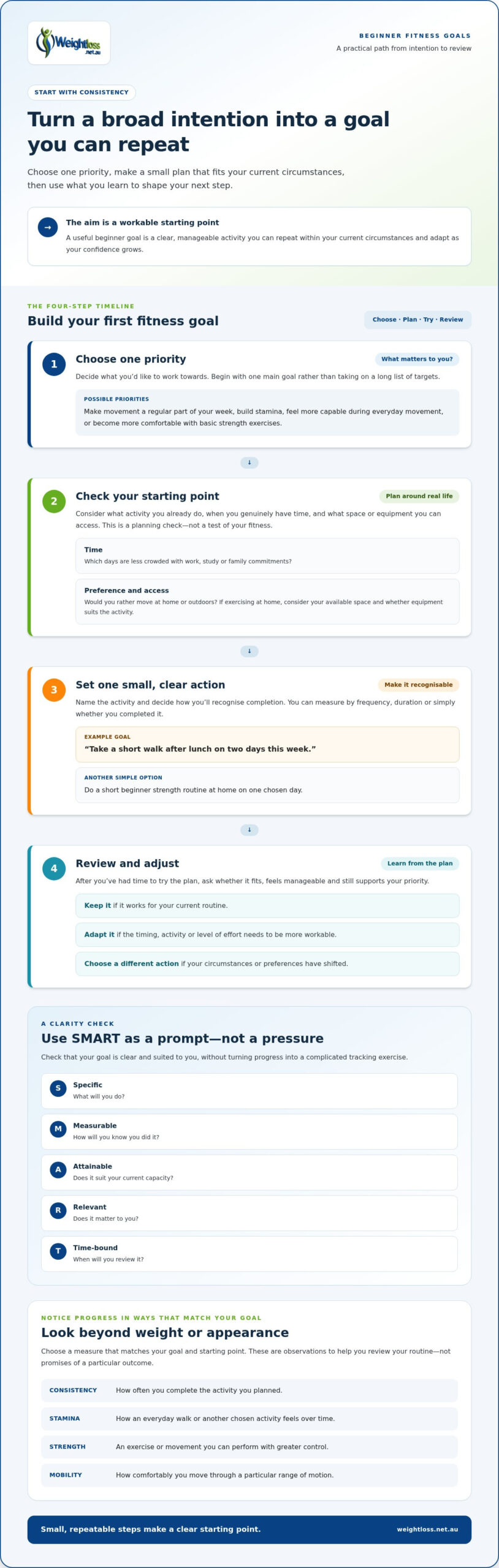
A good goal doesn’t need a complicated plan or a stack of tracking tools. It should connect what matters to you with an action that fits your current routine. Use the steps below to turn a general intention into something you can try, observe and revise.
- Choose a priority. Decide what you’d like to work towards, such as feeling more comfortable with basic strength exercises or making movement a regular part of the week.
- Identify your starting point. Consider what activity you already do, which times are genuinely available and what space or equipment you can access. This is a planning check, not a test of your fitness.
- Set one small action. Name an activity and how you’ll measure completion, such as doing a short beginner strength routine at home on one chosen day. You can measure by frequency, duration or simply whether you completed it.
- Choose a review point. After you’ve had time to try the plan, consider whether it fits, feels manageable and still supports your priority. Keep it, adapt it or choose a different action.
This process gives fitness goals for beginners a practical shape without making every detail a target. SMART is a useful prompt: make the goal specific (what will you do?), measurable (how will you know you did it?), attainable (does it suit your current capacity?), relevant (does it matter to you?) and time-bound (when will you review it?). Treat SMART as a check for clarity, not a demand to track every part of your life.
Choose a goal that fits your life and starting point
Start with your preferences and practical circumstances. Do you enjoy moving at home, or would you rather be outdoors? Which days tend to be less crowded with work, study or family commitments? If you’re considering home exercise, factor in your available space and whether equipment would suit the activity. Choose one main goal to begin with rather than borrowing a long list of targets that may not fit your week.
Your reason and your action are related, but they’re not the same. “I want to feel more capable” can be a meaningful personal reason; “practise a beginner strength session once this week” is an action you can plan. Keeping that distinction helps turn motivation into a clear next step.
Make the goal specific, measurable and flexible
Replace “get fitter” with an action you can recognise, such as completing a short mobility routine on two evenings each week. That describes what to do and how often without requiring complex data. Pick a check-in date as a chance to learn, not a pass-or-fail deadline. If the routine clashes with changing commitments, adjust the timing, activity or frequency so the goal remains useful.
A useful goal names an action and a review point, so you know what to try and when to decide what comes next. If a home-based routine suits your plan, explore home fitness equipment and wearable technology as optional ways to support or observe your chosen activity.
Which beginner fitness goals can you choose from?
There isn’t one ideal starting goal. The right choice depends on what you want to practise and what feels workable in your week. Think of the options below as a menu, not a checklist. Pick one focus to begin with; you can explore other areas later if they become relevant.
| Goal type | Beginner-friendly example | What it helps you track |
|---|---|---|
| Consistency | Schedule a chosen activity on a day that usually suits you, then record whether you did it. | How regularly movement fits into your routine. |
| Cardiovascular fitness | Try walking, cycling or another accessible activity, and notice how the effort feels. | Time spent moving and how your stamina feels during the activity. |
| Strength | Practise a simple bodyweight movement, such as a sit-to-stand, with attention to control. | Your comfort and confidence with that movement. |
| Mobility | Set aside time for gentle movements that help you explore a comfortable range of motion. | How easily you move through the positions you’re practising. |
| Recovery | Make space in your plan for a rest day or an easier activity when you need it. | How your routine balances activity with time to recover. |
Activity and consistency goals for building a routine
If your main aim is to make movement a regular part of life, focus on scheduling rather than hitting a performance benchmark. You might plan a walk, a dance session or another activity you enjoy, then adapt how often or how long you do it to suit your starting point. Fun group activities at trampoline parks such as Cool Springz can also make physical movement something you look forward to. A shorter session can be a useful first step; there’s no need to adopt someone else’s target.
Strength, mobility and stamina goals
Capability-based goals give you something specific to notice: perhaps a familiar movement feels more controlled, a stretch feels more comfortable or an everyday activity feels less tiring. These aims can sit alongside a consistency goal, but they don’t require a gym or a particular piece of equipment. Choose a movement that suits your space and ability, and focus on practising safely rather than pushing through discomfort.
For fitness goals for beginners, ask yourself: “What would I like to practise, and what would tell me it’s becoming more familiar?” That might be completing a planned activity, feeling steadier with a movement or getting to know what kinds of exercise you enjoy. Your answer doesn’t need to match anyone else’s.
Keep the goal small enough to test in your real routine. If it feels awkward, change the activity, timing or amount rather than adding more targets. Home fitness equipment may support a chosen activity if it suits your space, while wearable health technology is an optional way to observe activity patterns. Neither is a requirement for starting. Choose only what helps you follow the goal you’ve selected.
How to practise, track and adjust your beginner fitness goals
A goal becomes easier to work with when you have a simple way to plan it and learn from each attempt. Keep the process light: decide when you’ll be active, note what happened, then use your experience to shape the next week. You’re looking for useful feedback, not a perfect record.
Build a repeatable weekly routine
At the start of the week, choose realistic time slots for your planned activity. Consider what tends to disrupt those times, then name a straightforward backup, such as moving the activity to another day or choosing a shorter version. Rest and lighter days can be part of your plan too. They give your routine flexibility instead of making every day feel like a test.
Make starting simpler where you can. Set out comfortable clothing or prepare suitable home fitness equipment if it matches the activity and your space. These small steps can reduce the number of decisions between you and getting started. Keep a paper log or calendar nearby, use a note on your phone, or explore a dedicated lifting platform like ironpathapp.com if strength training is your focus. The best option is the one you’ll actually use.
Review progress without turning it into pressure
After each planned activity, record whether you completed it and add a brief note about effort, confidence or how everyday movement felt. A wearable can offer another way to observe activity patterns, but its data is optional information, not a verdict on your effort or success. If numbers distract you, a simple tick and a few words may be more helpful.
Tracking should inform your decisions, not create pressure to prove your progress. At the end of the week, ask yourself:
- Did the planned times fit around my other commitments?
- How did the activity feel during and afterwards?
- What would make the plan more workable next week?
Use your answers to decide what to do next. If the plan felt manageable and suited your routine, maintain it. If it regularly didn’t fit, reduce the frequency or duration, change the timing or try a different activity. If it felt comfortable and you want a little more challenge, build gradually rather than changing several things at once. A missed session can reveal a scheduling issue; it doesn’t erase the activity you did complete.
For fitness goals for beginners, a weekly review is a practical chance to respond to real life. Busy periods, changes in energy or a shift in what you enjoy may all call for an adjustment. There’s no need to restart from scratch. Keep the parts that work, revise the parts that don’t, and let your routine develop at a sustainable pace.
If home activity suits your plan, explore home fitness equipment as an optional support. Choose only what fits your chosen activity and available space.
How to keep beginner fitness goals sustainable over time
A routine doesn’t have to stay unchanged to be worthwhile. Work, family commitments, energy and interests can shift, so a goal that fitted one month may need a rethink later. Set a review point after you’ve had time to try your plan. Ask whether the activity still matters to you, fits your circumstances and feels manageable. Then maintain it, make a small adjustment or set a different goal.
What to do when motivation or routine changes
Busy weeks and interruptions happen. Rather than waiting for the “perfect” time to restart, return with a smaller version of your chosen activity, such as a shorter session or a simpler movement. If your schedule has changed, move the activity to a more realistic time. If you’ve lost interest, try another form of movement that suits you better now. This is adapting, not starting from zero.
Low confidence can also make a plan feel harder to approach. Reduce the pressure by focusing on the next manageable action, not on catching up for sessions you missed. Notice what got in the way and make the plan easier to begin. If personal health concerns could affect the activity you’re considering, seek advice from a qualified health professional before starting or changing your routine.
Choose support that makes your plan easier to follow
Optional supports are most useful when they solve a clear problem. If exercising at home suits your preferences, home fitness equipment may help you practise your chosen activity in the space you have. Choose equipment to match the routine rather than feeling you need to build a full home gym before you can begin. Comfortable workout apparel may also make getting ready feel simpler.
A wearable can be an optional way to observe activity patterns, such as when you tend to move more. Treat that information as context, not a measure of your worth or a guarantee of progress. If tracking feels distracting, put it aside and use a calendar or personal notes instead. Look for support that makes your plan easier to follow, not another task to keep up with.
If you’re considering optional equipment or wearable supports, explore wellness products for functional health with your chosen activity and available space in mind. The right support is the one that fits your actual routine.
For now, choose one small next step: keep the goal that’s working, adjust one part that isn’t, or return with a gentler version after a break. Sustainable fitness goals for beginners leave room for real life and personal change. If home fitness equipment or wearable health technology could support your plan, explore optional fitness supports and focus on what genuinely helps you get started.
Choose one next step and let your plan grow
You don’t need to map out your whole fitness future today. Choose one action you can try in the coming week, then give yourself permission to learn from it. If it fits, keep going. If it doesn’t, change the approach. A useful plan can evolve as your confidence, routine and interests change.
That’s the heart of fitness goals for beginners: making progress personal enough to continue, rather than measuring yourself against someone else’s pace. Support can be practical too. Home fitness equipment may suit the activity and space you have, while wearable health technology can help you observe activity patterns if you find that useful. Neither needs to define your progress.
Explore wellness and fitness products to support your routine and consider whether any option has a clear place in the plan you’ve chosen. Start with what feels manageable, stay curious about what works for you, and take your next step with confidence.
Frequently Asked Questions
What is a good first fitness goal for a beginner?
A good first goal is one clear action that feels manageable in your current week. For example, you could choose a beginner-friendly dance video at home and aim to complete it on a day you’re usually free. Make the goal easy to recognise as done, then notice whether the activity suited you. The best fitness goals for beginners aren’t necessarily impressive; they give you a useful place to start.
Can I set fitness goals without focusing on weight loss?
Yes, you can set fitness goals around what you want to do or how you want to feel, without making weight loss the measure. You might aim to feel more at ease joining a social activity, become more confident using stairs or learn a new movement. Choose a goal that reflects what matters to you. Your reasons can be personal, and your progress can be judged by the capability or experience you’re working towards.
Is walking enough to be a fitness goal for beginners?
Yes, walking can be a worthwhile goal if it’s an activity that suits your ability and circumstances. You could plan a walk along a familiar route and notice how comfortable the pace feels, or set a goal to explore a new path when you’re ready. Walking doesn’t have to be your only form of movement, though. If you want to work on other priorities, you can add different activities over time.
How do I make a fitness goal more realistic?
Make a goal more realistic by checking it against your actual week, not an idealised version of it. Consider travel time, caring responsibilities, weather, energy and where you can comfortably be active. If the plan depends on several things lining up, simplify it. For example, choose an activity you can do at home as well as outdoors, so a change in conditions doesn’t automatically derail your plan.
What should I do if I miss a workout or fall behind my goal?
Pick up with the next planned opportunity rather than trying to make up for every missed session. A missed workout may simply mean your schedule changed or you needed a break. If the same obstacle keeps appearing, adjust the plan around it. You could move the activity to a different time, choose a shorter option or pause and reset your goal. If you feel unwell or have a health concern, prioritise appropriate advice over catching up.
Do beginners need a fitness tracker to reach their goals?
No, a fitness tracker isn’t essential. You can keep track with a calendar, paper notes or a simple mental check-in about what you did and how it felt. A wearable may be useful if you’re curious about activity patterns, but treat its readings as one source of information rather than a scorecard. If the data makes you anxious or distracts you from enjoying movement, use a simpler tracking method instead.