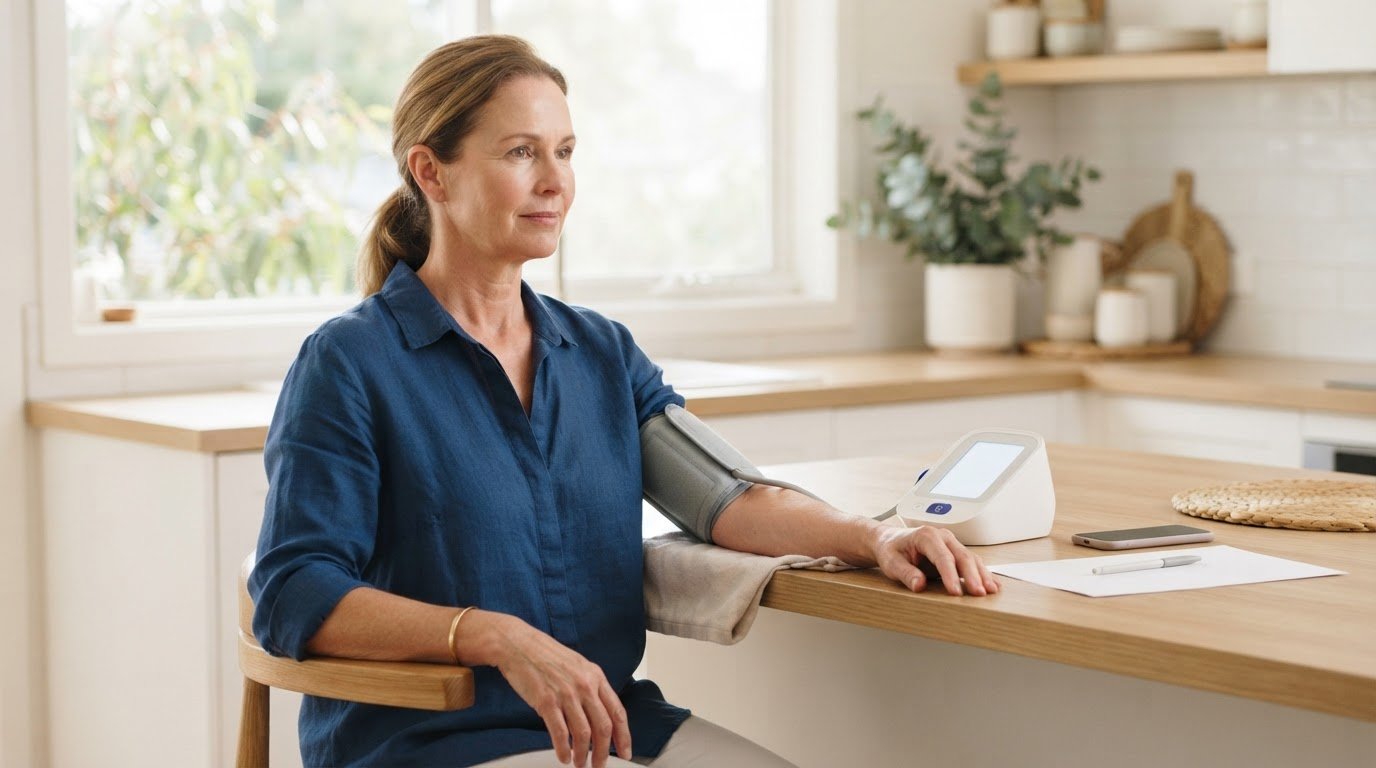
The most feature-packed blood pressure monitor isn’t always the best choice for your home. A monitor with a cuff that fits correctly and a routine you can stick to is more useful than extra functions you may never use. If you’re comparing blood pressure monitors for home use, it can be hard to know which cuff style, accuracy information and features deserve your attention.
This guide compares upper-arm and wrist monitors, explains why fit and clinical validation matter, and helps you choose a device that suits your body and routine. You’ll also find practical steps for preparing for a reading, using your monitor consistently and keeping a record to discuss with your GP.
When comparing products in Australia, check the device’s current registration and clinical validation information, but don’t let app features or marketing claims distract from the basics. The measurement steps below can help you build a repeatable routine and share useful information with a health professional.
Key Takeaways
- Compare upper-arm, wrist and manual monitors to find an option that suits your body and routine.
- When choosing blood pressure monitors for home use, prioritise a suitable cuff, clear instructions and evidence of clinical validation over a long feature list.
- Use a repeatable measurement routine, including a quiet five-minute rest, to help make your readings more consistent.
- Keep a clear record of readings so you can discuss patterns with your GP.
- Treat price and extra features as secondary considerations. Neither one establishes whether a monitor is suitable or accurate.
Why use a blood pressure monitor for home use? Understand what home readings can tell you
A home blood pressure monitor uses a cuff, usually placed around your upper arm or wrist, to measure the pressure of blood moving through your arteries. Each result is a snapshot taken at a particular moment in your usual surroundings. When a health professional recommends home monitoring, a series of readings can add useful context to an appointment or treatment review.
A home monitor records blood pressure; it doesn’t diagnose a condition or replace assessment by a health professional. A result can be affected by recent activity, stress or the way the measurement was taken. One reading cannot establish a diagnosis, explain every symptom or show your usual pattern by itself.
What do the numbers on a blood pressure reading mean?
Blood pressure is shown as two numbers. The first, or top number, is systolic pressure, the pressure in your arteries as your heart beats. The second, or bottom number, is diastolic pressure, the pressure between beats while your heart rests.
A result such as 120/80 mmHg is read as “120 over 80”. The letters mmHg mean millimetres of mercury, a traditional unit for measuring pressure. This example explains the format; it isn’t a personal target. Suitable targets depend on your health and clinical advice, so ask your GP or treating health professional what your readings mean for you.
When might home monitoring be useful?
A health professional may recommend home monitoring to see how readings change over time, support an assessment or review how a treatment plan is working. Your GP might ask you to measure at particular times and keep a log. Follow the schedule you’re given, and don’t change medication or draw conclusions from a single result.
Make your record useful by noting each result with its date and time. Add relevant context, such as feeling unwell or missing a planned measurement. A clear log can help your GP discuss patterns and decide whether further assessment is needed. Digital monitors, also called sphygmomanometers, measure blood pressure in different ways. What is a Sphygmomanometer? offers an overview of the device and its history.
Home monitoring is for planned tracking, not a reason to wait out concerning symptoms. If you have severe symptoms such as chest pain, difficulty breathing or sudden weakness, seek urgent medical care rather than relying on another reading. A monitor can’t explain what is causing symptoms. If you’re unsure what to do, contact a health professional promptly.
Blood pressure monitors for home use can help build a fuller picture when you take readings consistently and share them appropriately. They’re one part of care, not a substitute for your GP’s assessment or advice.
Upper-arm or wrist blood pressure monitor: compare the main options
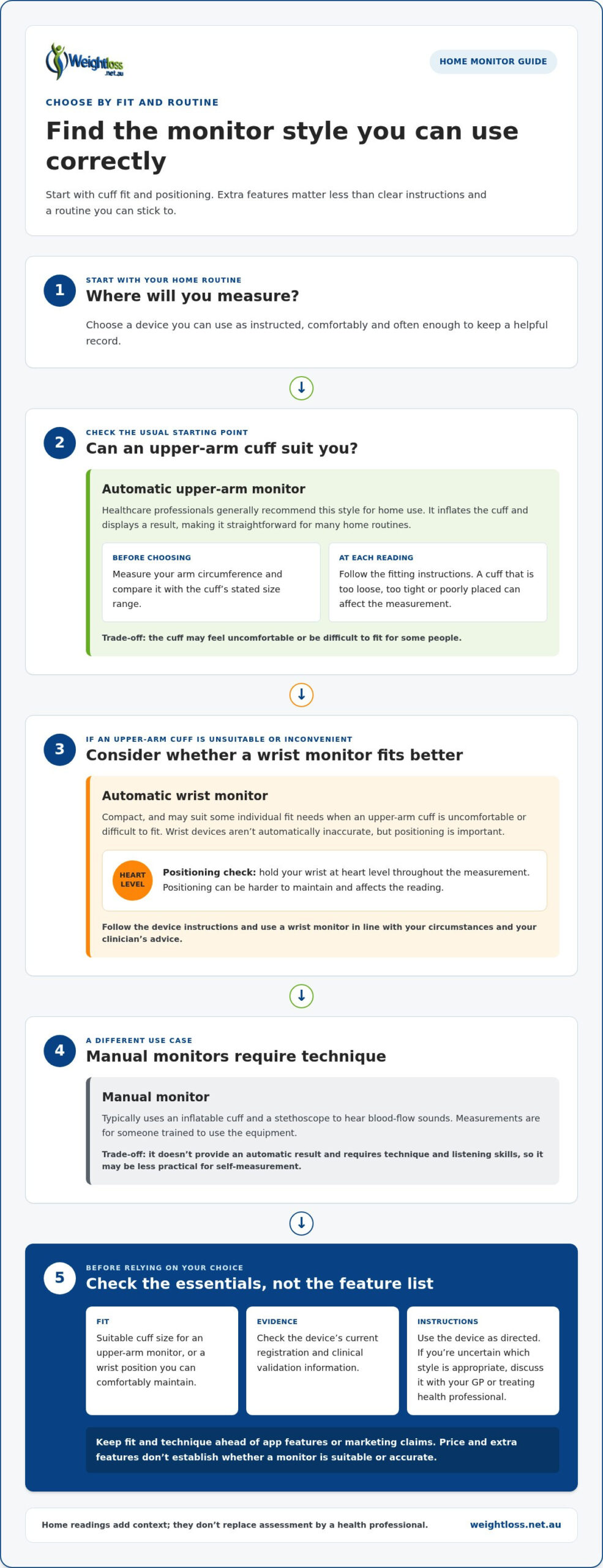
For many people, an automatic upper-arm monitor is a practical starting point because healthcare professionals generally recommend this style for home use. Comfort, cuff fit and your ability to position the device correctly matter too. Choose a monitor you can use as instructed and often enough to keep a helpful record.
| Monitor type | Typical use | Fit and positioning | Main trade-offs |
|---|---|---|---|
| Automatic upper-arm | Routine home measurements | Cuff wraps around the upper arm; choose a size that matches the device instructions and your arm circumference. | Often a guidance-led starting point, but the cuff may feel uncomfortable or be difficult to fit for some people. |
| Automatic wrist | Home use where an upper-arm cuff is unsuitable or inconvenient | Device sits on the wrist, which must be held at heart level during measurement. | Portable and may suit some individual fit needs, but positioning can be harder to maintain and affects the reading. |
| Manual | Measurements by someone trained to use the equipment | Typically uses an inflatable cuff and a stethoscope to hear blood flow sounds. | Doesn’t provide an automatic result and requires technique and listening skills, so it may be less practical for self-measurement. |
When is an upper-arm monitor a practical choice?
An automatic upper-arm monitor inflates the cuff and displays a result, which makes it straightforward for many home routines. Before choosing one, measure your arm circumference and compare it with the cuff’s stated size range. Follow the fitting instructions each time. A cuff that is too loose, too tight or poorly placed can affect the measurement. If an upper-arm cuff isn’t suitable for you, a health professional may recommend another approach.
When might a wrist monitor suit someone better?
A wrist monitor is compact and may suit you if an upper-arm cuff is uncomfortable or difficult to fit. Wrist devices aren’t automatically inaccurate, but correct positioning is important: hold your wrist at heart level throughout the measurement. Follow the device instructions and use a wrist monitor in line with your circumstances and your clinician’s advice.
Whichever style you consider, prioritise correct fit and technique over a long list of features. For an upper-arm device, compare your arm circumference with the cuff size range. For a wrist device, make sure you can comfortably hold the required position. If you’re uncertain which style is appropriate, discuss it with your GP or treating health professional before relying on home readings.
As you compare blood pressure monitors for home use, think about where and how you’ll take measurements, not just what the display can do. Once you know which type and fit you need, you can explore health and wearable technology products as part of your broader wellness planning.
Which blood pressure monitor features are genuinely useful at home?
A large screen, phone alerts or an extensive feature list can be appealing, but start with the essentials: check clinical validation, suitable cuff fit and clear instructions before comparing convenience features. These are central to choosing an appropriate device and using it as intended.
For a monitor sold in Australia, check whether it’s included in the Australian Register of Therapeutic Goods (ARTG). This is a regulatory check, not proof by itself that a device has been clinically validated. Look for evidence that the exact model has been tested for accuracy using recognised clinical validation standards. A familiar brand name or an advertising claim isn’t a substitute for checking the model.
Then confirm that the cuff fits the person who’ll use it and that the instructions explain how to take a measurement. Clear, readable guidance can be more useful than extra technology, especially when you’re measuring without help. These are the practical foundations to assess when choosing blood pressure monitors for home use.
Do memory, multiple-user profiles and apps make monitoring easier?
They can, if they suit your routine. Built-in memory may save readings so you don’t have to copy each result by hand. Multiple-user profiles can keep household members’ records separate, while an app may show a history that’s easier to review or share. These features help with record keeping; they don’t interpret results or replace clinical advice.
A notebook or simple written log can work just as well. Before choosing an app, consider whether it’s easy to use, compatible with your phone and clear about its privacy settings. Check how readings are stored and shared, and whether you can access them without relying on a particular phone. Choose a method you’ll use consistently and can show your GP when needed.
What do irregular-heartbeat indicators actually tell you?
An irregular-heartbeat indicator means the monitor detected a pulse pattern it flags during measurement. It doesn’t independently diagnose atrial fibrillation or explain what caused the alert. Follow the device’s instructions and discuss repeated alerts or concerns with a health professional. If you’re considering this feature, read the exact model’s instructions to understand what its indicator means and what action it recommends.
App charts, stored readings and alerts can make a record easier to manage, but none should be treated as a diagnosis. Take readings as directed and share relevant patterns or repeated indicators with your GP. If a device’s extra functions make it confusing to use, a simpler validated monitor may be a better fit for your needs.
How to get more consistent readings from a home blood pressure monitor
Preparation and posture can affect a reading, so build a simple routine you can repeat. Healthdirect recommends resting quietly for five minutes before measuring. Follow your health professional’s schedule if they’ve provided one; there isn’t a single measurement timetable that suits everyone.
How should you prepare and position yourself before a reading?
Before measuring, check your monitor’s instructions for cuff placement and any model-specific steps. For a more settled measurement, avoid exercise, caffeine and smoking for 30 minutes beforehand. Then sit quietly for five minutes. Rest first, sit with your back supported and feet flat, and keep your supported arm relaxed at heart level.
- Get settled. Sit in a quiet spot with your back supported. Keep both feet flat on the floor and don’t cross your legs.
- Position your arm. Rest it on a table or other support so the cuff is level with your heart. Keep your hand relaxed.
- Fit the cuff. Place it on bare skin as shown in the monitor instructions. Check that it’s the right size and positioned correctly; clothing or a loose, misplaced cuff can affect the result.
- Take the measurement. Stay still and quiet while the monitor runs. Avoid talking, moving or looking at your phone until it finishes.
- Record the result. Write down the reading straight away, along with the date and time. Follow your clinician’s instructions about whether to take further readings.
Consistency makes readings easier to compare. If your GP has asked you to measure at particular times, follow that plan rather than choosing a different schedule based on general advice. The setup matters as much as the device: even a monitor with useful features can produce a misleading result if you use it in the wrong position.
How should you record readings and respond to unusual results?
Keep a straightforward log on paper or in a device app. Record the date, time and result, and add brief context if something may have affected the measurement, such as feeling unwell or taking it after activity. Bring or share the record with your GP or another health professional when it’s relevant to your care.
An unexpected result can be unsettling. Check that you followed the instructions, then take any repeat measurement only as directed by your health professional or monitor guidance. Don’t change medication based on a home reading alone. If unusual readings persist or you’re concerned about what they mean, contact a health professional. For worrying or severe symptoms, seek medical advice promptly rather than relying on another measurement.
A repeatable routine makes readings from blood pressure monitors for home use more useful to discuss with your GP. For broader wellness planning, explore health and wearable technology products alongside the habits that support your health goals.
Choose a home blood pressure monitor that fits your routine and next steps
The most suitable monitor is one you can fit correctly, operate comfortably and use as your health professional advises. Focus on practical essentials rather than choosing by price or feature count alone. Neither one establishes whether a device suits you or is clinically accurate.
- Cuff fit: Check that the cuff’s size range matches the user and that the device instructions show how to position it.
- Validation: Check that the exact device model has evidence of clinical validation. In Australia, also check its inclusion in the Australian Register of Therapeutic Goods (ARTG); registration and clinical validation are separate considerations.
- Ease of use: Look for instructions, controls and a display you can follow without guesswork.
- Record keeping: Decide whether you’ll reliably use stored readings, an app or a written log to keep results together.
Which monitor features suit different home routines?
If you prefer a simple setup, a clear display and straightforward controls may be all you need. If you like reviewing trends digitally, memory or connected records could make it easier to organise readings. Either way, first make sure the cuff fits, the instructions are clear and the device suits any guidance from your GP or treating health professional.
Convenience should support your routine, not complicate it. An app may help if you already use a compatible phone and are comfortable with its privacy settings. If you’d rather avoid syncing and managing an app, a monitor with memory or a paper log may feel more manageable. Choose an approach you’ll maintain and can share when discussing your results.
What should you do after choosing a monitor?
Read the instructions before relying on a series of results. Practise fitting the cuff and taking a measurement so you can spot anything unclear; if needed, ask a health professional to explain the technique. Agree on how often to measure and what targets apply to you. These details depend on your circumstances and clinical advice, not a universal schedule or a device’s suggested range.
Weightloss and Wellness is an Australian marketplace featuring curated wellness and wearable health technology from external retailers. Once you’ve identified what you need, explore its 2026 wellness products guide for broader health-tech ideas. Product referrals may lead to external retailers.
A good choice fits your body, your day-to-day routine and the monitoring plan you’ve discussed with a health professional. Use blood pressure monitors for home use to keep a consistent record, then bring those results into a wider conversation about your health.
Make your next step a steady one
Choosing blood pressure monitors for home use is one part of building a useful monitoring habit. Make a manageable plan, follow the guidance you’ve agreed with your health professional and keep your readings organised. This gives you a practical way to bring questions and patterns into future conversations about your health.
If you’re also exploring tools to support your wellbeing, Weightloss and Wellness is an Australian-focused affiliate marketplace with curated health, fitness and wearable health technology categories. Product referrals connect readers with external retailers and offer a starting point for discovering broader wellness products.
Explore curated wellness and health-tech products to find tools for your broader wellbeing routine, and take the next step at a pace that works for you.
Frequently Asked Questions
Are upper-arm blood pressure monitors more accurate than wrist monitors?
Automatic upper-arm monitors are commonly recommended for home use, but a monitor isn’t reliable simply because of its style. Accuracy depends on using a clinically validated device with a cuff that fits, and following the instructions. Wrist monitors may suit some people if they can hold the device at heart level during measurement. If you’re considering different blood pressure monitors for home use, follow your clinician’s advice about the most appropriate option.
How often should I check my blood pressure at home?
How often to measure depends on why you’re monitoring and the plan agreed with your health professional. Healthdirect notes that a clinician may ask for readings twice daily for seven days, but this is an example, not a schedule for everyone. Follow the timing you’ve been given and record each result consistently. Before changing an established routine, check with your GP or treating health professional.
Can a home blood pressure monitor give a false reading?
Yes. Preparation, posture, cuff fit, technique or the device’s condition can affect a result. Check the manual if readings seem inconsistent and make sure you’re using the monitor as directed. One unexpected result doesn’t diagnose a health condition. Keep a consistent record and discuss repeated unusual readings with a health professional rather than relying on one measurement to make decisions about your care.
What size blood pressure cuff do I need?
Choose a cuff whose stated circumference range includes the measurement of the arm being monitored. Follow the device manual for how and where to measure, then compare the result with the cuff range on the packaging or in the instructions. Don’t assume a standard cuff will fit everyone: a cuff that’s too small or too large may affect readings. If you’re still unsure about fit, ask a health professional for guidance.
Do I need a Bluetooth blood pressure monitor?
No, Bluetooth isn’t required to measure blood pressure. A connected monitor may make it easier to store or share readings, while a paper log can be a practical alternative. Consider whether the app works with your phone, is straightforward to use and suits your privacy preferences. App graphs can help organise information, but they don’t interpret results or provide a diagnosis. Choose the record-keeping method you’ll keep using.
Can a blood pressure monitor detect atrial fibrillation?
Some monitors may show an irregular-heartbeat or AFib-related indicator, but features and their meaning vary by model. Check the current instructions for the exact device to understand what an alert signals and what steps it recommends. An indicator can’t diagnose atrial fibrillation, and no alert doesn’t rule it out. If you receive repeated alerts or have concerns about your heart rhythm, discuss them with a health professional.
When should I speak to a GP about home blood pressure readings?
Speak with your GP if readings are consistently concerning, you’re unsure about your personal target or your health changes. Your GP can interpret results in light of your circumstances and advise what to do next; one threshold may not apply to everyone. If you have severe or sudden symptoms, seek urgent medical care rather than waiting to collect more readings. Don’t adjust prescribed treatment based on home results without clinical advice.