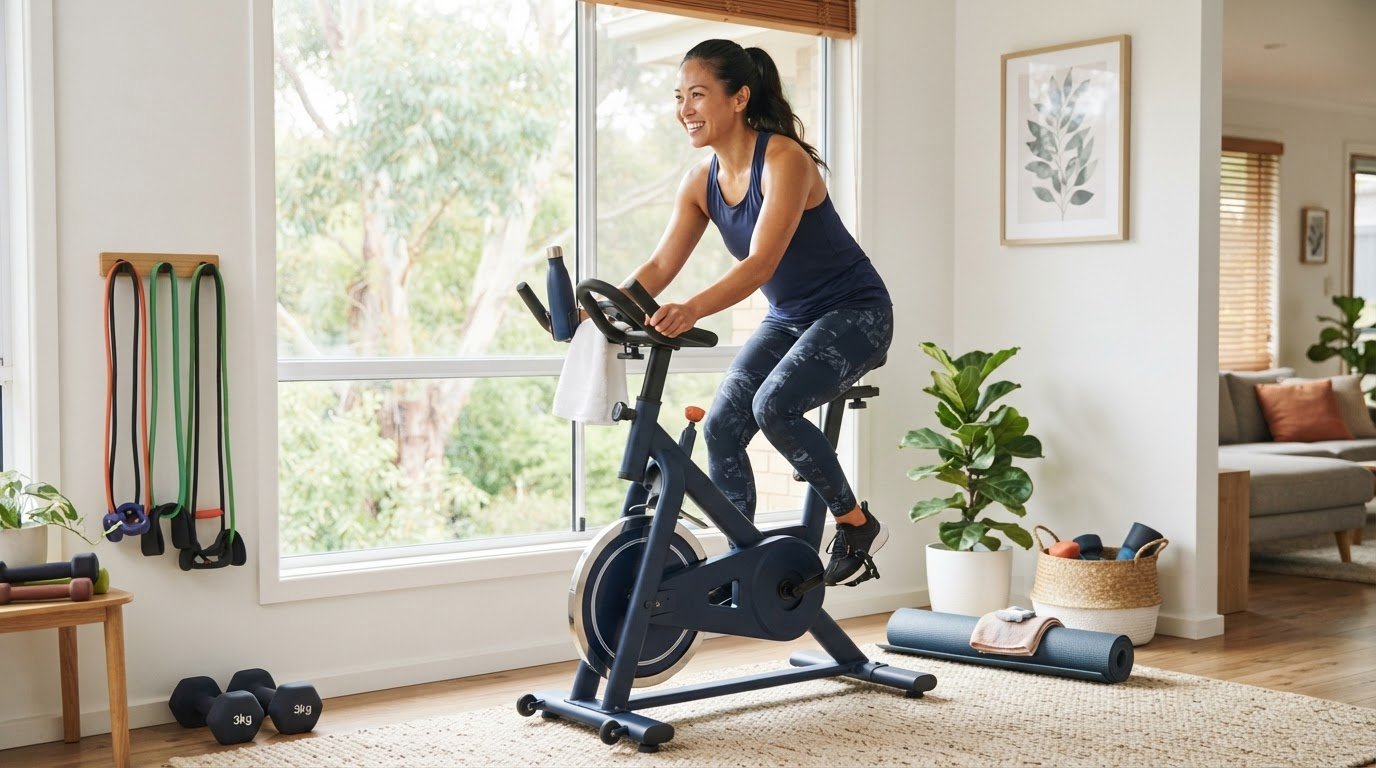
The best home exercise equipment for weight loss in Australia isn’t one machine or brand. A practical home setup can pair cardio equipment, such as a treadmill, exercise bike, rower or elliptical, with resistance tools like bands or dumbbells. The right combination suits your space, preferences and ability to exercise consistently.
It’s understandable to look for one piece of equipment that makes getting started feel easier. But weight loss isn’t determined by a machine alone. A routine that includes cardio and resistance training gives you more ways to build movement into your week.
This guide compares compact options, including resistance bands and jump ropes, with larger cardio machines. You’ll learn what each can contribute, what to consider when choosing, and how to put together a manageable, sustainable home setup.
Key Takeaways
- Choose a cardio machine by the movement you’re most likely to keep doing, and compare features such as adjustable speed, incline or resistance.
- Use resistance bands and other compact tools to add strength work without building your routine around a large machine.
- Plan your home setup around available space and the sessions you enjoy, rather than buying equipment you may not use.
- Keep your focus on consistent activity and eating habits; equipment can support a weight-loss plan, but it isn’t the plan itself.
Best home gym machine for weight loss?
The best fit depends on the activities you’ll do consistently and the space available. A balanced setup can combine cardio machines with strength equipment for different types of training.
Cardio machine options
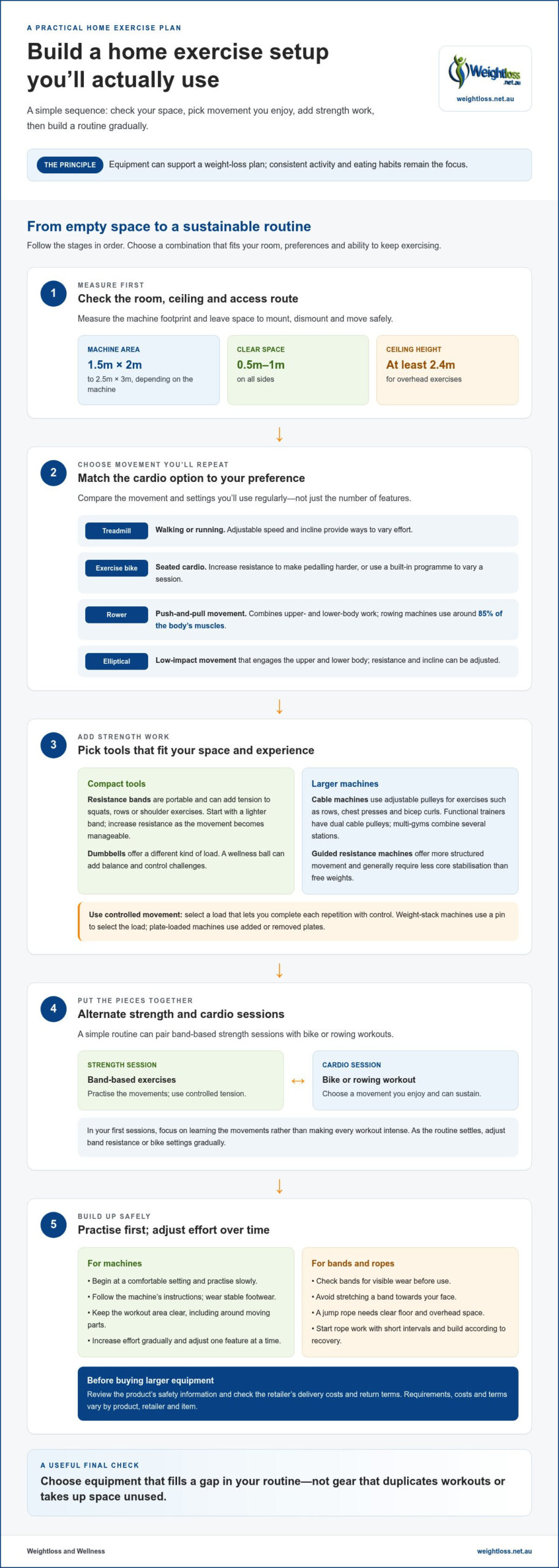
Treadmills suit walking or running, with adjustable speed and incline to change the effort. Exercise bikes offer seated cardio, while rowers combine upper- and lower-body movement; rowing machines use around 85% of the body’s muscles. Cross trainers, also called ellipticals, provide low-impact movement and engage the upper and lower body. Choose by the movement you can sustain and the machine’s settings.
For strength training, a cable machine uses adjustable pulleys for exercises such as rows, chest presses and bicep curls. Multi-gyms combine several stations, while functional trainers offer dual cable pulleys for varied exercises. Guided resistance machines can provide a more structured movement for beginners and generally require less core stabilisation than free weights. Before buying, consider whether the machine supports the exercises you want to repeat.
For Australian equipment purchases, safety requirements depend on the product, while delivery costs and return terms vary by retailer and item. Review the equipment’s safety information and the seller’s delivery and returns terms before buying.
If you’re a beginner, start with a comfortable setting, practise the movement slowly and follow the machine’s instructions before increasing effort. Wear stable footwear and keep the workout area clear.
Treadmills and other cardio machines can pose risks if you lose your balance, use poor technique or increase intensity too quickly. Check the machine’s setup and keep children and loose items away from moving parts.
Space and clearance requirements
Measure the machine’s footprint and leave room to mount, dismount and move safely. Home gym machines may need between 1.5m x 2m and 2.5m x 3m, depending on type, plus 0.5m to 1m of clear space on all sides. Most machines need a ceiling height of at least 2.4m for overhead exercises. Measure the room, ceiling and access route before choosing a machine.
Resistance bands, wellness balls and jump ropes
Resistance bands offer beginners a portable way to add strength work without a large machine. Start with a lighter band, then increase resistance as the movement becomes manageable. For example, a band can add tension to squats, rows or shoulder exercises. Power bands are another option for resistance sessions, while dumbbells provide a different kind of load.
A wellness ball can add balance and control challenges to exercises such as seated marches or supported body-weight movements. Keep your movements steady and choose exercises suited to your current ability. A jump rope offers a simple cardio option, but involves repeated hops and needs clear overhead and floor space. Start with short intervals and build your routine according to how comfortably you recover.
Weight stacks and plate-loaded machines adjust resistance differently. With a weight stack, select the load using its pin; with a plate-loaded machine, add or remove weight plates. A stack can make changing loads straightforward between exercises, while plate loading lets you control which plates you use. Whichever format you choose, use a load that allows you to complete each repetition with controlled movement.
On an exercise bike, increase resistance to make pedalling harder, or choose a built-in programme to vary the session. This can help structure cardio alongside strength work. Resistance bands can also suit warm-up or mobility routines, where controlled movements let you practise your range of motion before harder exercise. Avoid stretching a band towards your face, and check it for visible wear before use.
Build a simple weekly routine by alternating band-based strength sessions with bike or rowing workouts. Focus on learning the movements in your first sessions rather than making every workout intense. As your routine settles, adjust band resistance or bike settings gradually. A small set of accessories can help vary workouts without filling your home with equipment.
Explore home exercise equipment options to find tools that suit your space and the sessions you enjoy.
Treadmills, indoor cycles, rowers and ellipticals
Each cardio machine offers a different workout, so match the movement to your preferences and available space. Consider its settings, the muscle groups involved and the variety you’ll use regularly.
Indoor cardio machine types
A treadmill supports walking or running, while an indoor cycle keeps you seated. Rowers combine pushing and pulling, engaging the upper and lower body in one session. An elliptical, or cross trainer, also works the upper and lower body with low-impact movement. Compare these options with the type of exercise you enjoy, not just the number of features.
A home gym can combine cardio equipment with strength tools, but the machines serve different purposes. Dumbbells and plates provide resistance for strength exercises; a cycle or rower supports cardio. Choose equipment that fills a gap in your routine instead of duplicating workouts you already do. For those who find outfitting a dedicated space impractical, exploring options such as a gym membership Forest Hill London can provide full access to high-grade cardio and strength equipment without having to store it at home.
Speed and incline settings
A treadmill’s adjustable speed lets you shift between a steady walk and a faster pace. Incline gives you another way to vary a workout without changing machines. Start at a comfortable setting, then adjust one feature at a time as your fitness improves. For example, increase the incline while keeping speed steady, or change pace on a level surface.
Treadmill exercise is estimated to burn 500 to 1,000 calories per hour, depending on a person’s weight and effort. Treat that range as an estimate, not a target: actual energy use varies with both factors. Focus on a pace you can maintain with controlled movement instead of chasing a display figure.
Treadmill and elliptical features
Ellipticals allow you to adjust resistance and incline, giving you options to change effort and movement during a session. Their low-impact action can suit people seeking a gentler alternative to running. Treadmills offer adjustable speed and incline for varied walking or running workouts. Compare the controls and movement each machine offers before choosing.
Exercise bikes provide another adjustable cardio option, and an average person can burn over 500 calories per hour on a stationary bike. Elliptical exercise is estimated at around 500 calories per hour. These figures describe estimates, not guaranteed outcomes. Select the machine that makes it easiest to build regular sessions into your week.
Home exercise equipment and weight loss
Equipment supports a routine, but weight loss depends on maintaining a calorie deficit: burning more energy than you consume. A treadmill, exercise bike or set of dumbbells can help you move regularly, but the most useful choice is one that fits your week. Build a plan around cardio and strength training rather than expecting one machine to do everything. Some people also pair home workouts with dynamic disciplines like martial arts for functional conditioning; dedicated training schools such as Renzo Gracie NH provide helpful insight into how practices like Brazilian Jiu-Jitsu develop endurance and whole-body strength.
Is resistance training equipment useful for weight loss and preserving muscle? Yes. Resistance training while dieting can help prevent the body from breaking down muscle to make up for a calorie deficit. Bands, adjustable dumbbells or a cable machine give you ways to train against resistance. Start with controlled movements, then progress by adjusting resistance or choosing a more challenging variation.
A practical home setup can begin with adjustable dumbbells, a bench, a mat or suitable flooring, one cardio machine and a small selection of accessories. Dumbbells and a bench support strength exercises, while a bike or treadmill adds cardio. Choose equipment you can organise in your space and use for workouts you’ll repeat.
For functional strength training, a power rack and barbell can support exercises such as squats and presses. Unlike guided machines, this setup requires you to control the bar path and movement. Begin with exercises you can perform with steady technique, and add resistance gradually as your progress allows. Bands or dumbbells can suit a routine that doesn’t need a rack.
Consider joint comfort when choosing cardio equipment. A stair stepper can place relatively high impact on the knees, so it may not suit people prone to joint problems. Compare its movement with a stationary bike or elliptical before adding it to your home gym.
Explore home fitness equipment to shape a setup around your space, preferred workouts and strength goals.
Weightloss and Wellness: Affiliate Products from Amazon, Walmart and others
Weightloss and Wellness features affiliate products from Amazon, Walmart and other retailers, offering a place to explore options that support a fitness routine. Once you’ve identified the kind of home equipment that fits your space, browse exercise-related products alongside healthy diet products, wearables and health tech, and apparel and accessories.
These categories can complement different parts of a plan: equipment supports movement, while wearables can help you track activity. Choose items that suit your goals and habits rather than adding products without a clear purpose.
For a considered next step, visit Weightloss and Wellness to explore its available product categories.
Make your next step a manageable one
Choose one small change you can put into practice, such as setting aside a regular time to move or making your workout space easier to use. A routine that fits your day gives you a clearer starting point than waiting for the perfect setup. As you settle into it, notice which activities feel sustainable and adjust your plan accordingly.
If you’re still weighing up the best home exercise equipment for weight loss in Australia, focus on what supports your habits, space and goals. Weightloss and Wellness features affiliate products from Amazon, Walmart and other retailers, alongside healthy diet products and wearables and health tech items. These categories can complement your approach to fitness and wellbeing.
For a next step, contact Weightloss and Wellness to explore its offerings. Start with a choice that feels practical, then build on it steadily.
Frequently Asked Questions
What is the best home gym equipment brand in Australia?
There isn’t one home gym brand that suits every Australian. Choose equipment for your space, budget and preferred movement. Weightloss and Wellness is an affiliate marketplace, not an equipment manufacturer, and its pages link to products from retailers. Affiliate links may earn a commission at no extra cost to you. The site’s information is for reference only, not medical advice or product endorsement. Consult a doctor before changing your diet or starting a weight-loss program.
How much does a full home gym cost in Australia?
The cost of a full home gym depends on what you include and the level of equipment you choose. A setup with adjustable dumbbells differs from one with a cardio machine, power rack, bench, barbell and plates. Flooring and accessories also affect the total. To plan your setup, list essential equipment for your workouts first, then add items that fill a clear gap rather than duplicate what you already have.
What home exercise equipment is most effective for weight loss?
The most useful equipment is what helps you maintain regular activity and combine cardio with resistance work. For example, pair a cardio machine with dumbbells or resistance bands, then plan sessions you can repeat. Equipment can support weight loss, but it doesn’t replace sustainable eating and activity habits. Track which workouts you complete, and adjust your routine if a piece of equipment is rarely used.
How many calories do treadmills, exercise bikes, rowing machines and ellipticals burn per hour?
Treadmill exercise is estimated at 500 to 1,000 calories per hour, depending on body weight and effort. A stationary exercise bike can burn over 500 calories per hour for an average person, while an elliptical is estimated at around 500. Rowing-machine energy use varies with pace and effort, so don’t assume it matches another machine’s estimate. Treat calorie displays as estimates, not personal measurements.
What is the best home cardio equipment for beginners and different fitness levels?
If you’re a beginner, choose a machine with a movement and controls that feel manageable. An exercise bike lets you adjust resistance, while a treadmill offers adjustable speed and incline; an elliptical provides another low-impact option. More experienced users can vary settings or workout styles to increase the challenge. Whichever you choose, start at a comfortable effort and change one setting at a time.
How much does home exercise equipment cost in Australia?
Equipment costs vary with the type, construction and number of features. Compact accessories such as bands differ in cost from larger machines or multi-station setups. When comparing options, consider the machine’s intended use, the space it needs and whether it replaces or complements existing gear. Prioritise what you’ll use regularly, then build your setup gradually instead of buying several items at once.