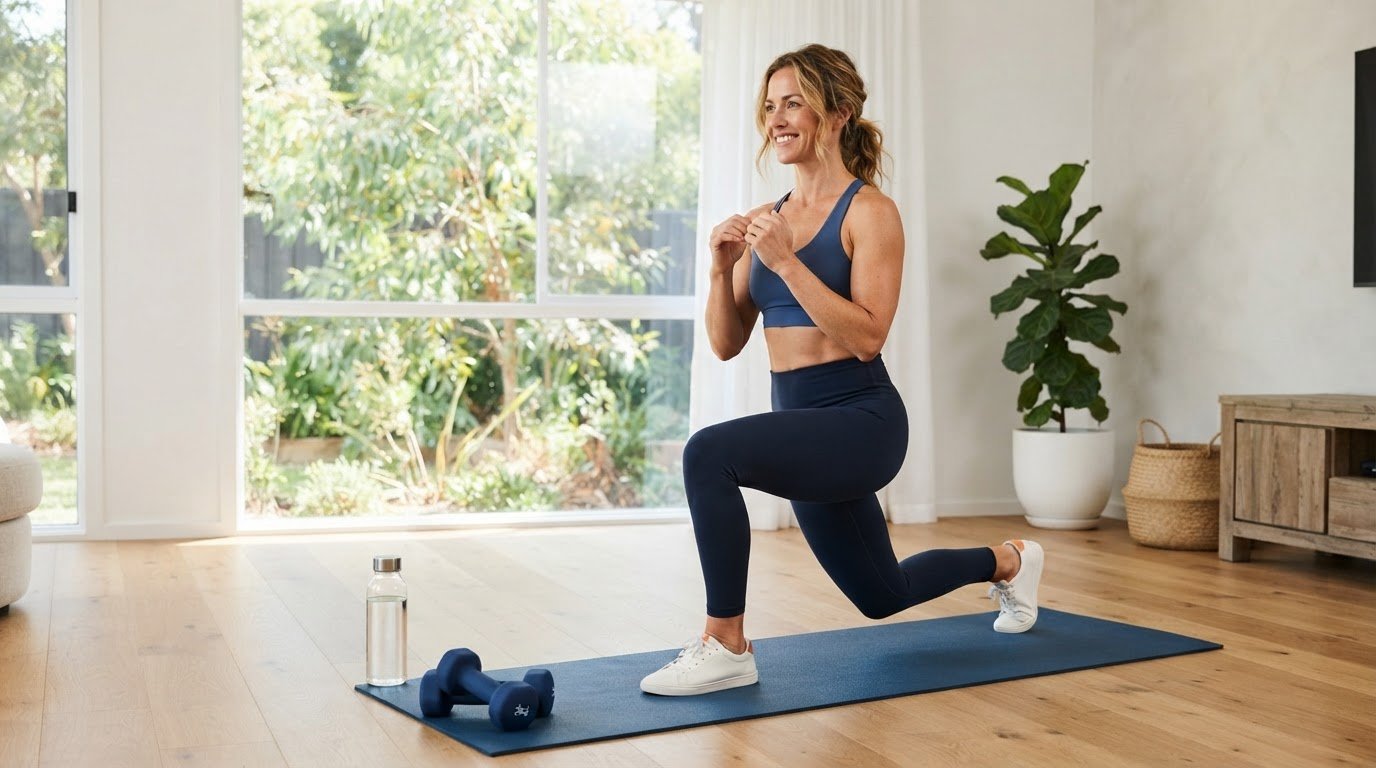
A home workout plan for weight loss should combine cardio, resistance training and a manageable approach to food intake. In Australia, the Australian Government Department of Health and Aged Care recommends 150-300 minutes of moderate-intensity activity each week and resistance exercise on at least two days per week. Exercise can strengthen muscles in a chosen area, but it can’t reliably direct fat loss from only that spot.
It’s understandable to hope that extra exercises for your stomach, arms or thighs will slim those areas first. In practice, a sustainable home workout plan for weight loss supports overall fat loss while helping you build strength and fitness, rather than promising control over where your body loses fat.
This guide explains how to organise home workouts, where cardio fits and how to pair activity with calorie intake and weight-loss nutrition. You’ll also learn how to progress steadily, allow time for recovery and make your plan practical enough to stick with.
Key Takeaways
- Balance cardio with resistance work and choose activities you can fit into your regular routine.
- Set a realistic nutrition approach by considering your energy needs, food choices and consistency over time.
- Adjust sets, repetitions and rest to suit your current ability, then progress gradually as exercises become more manageable.
- Build sessions around practical home movements, and use equipment or health products only when they support your routine.
Is cardio good for weight loss?
Cardio contributes to an active routine, while resistance training helps maintain strength. Combine both with recovery and a manageable weekly schedule.
-
Plan cardio and strength training
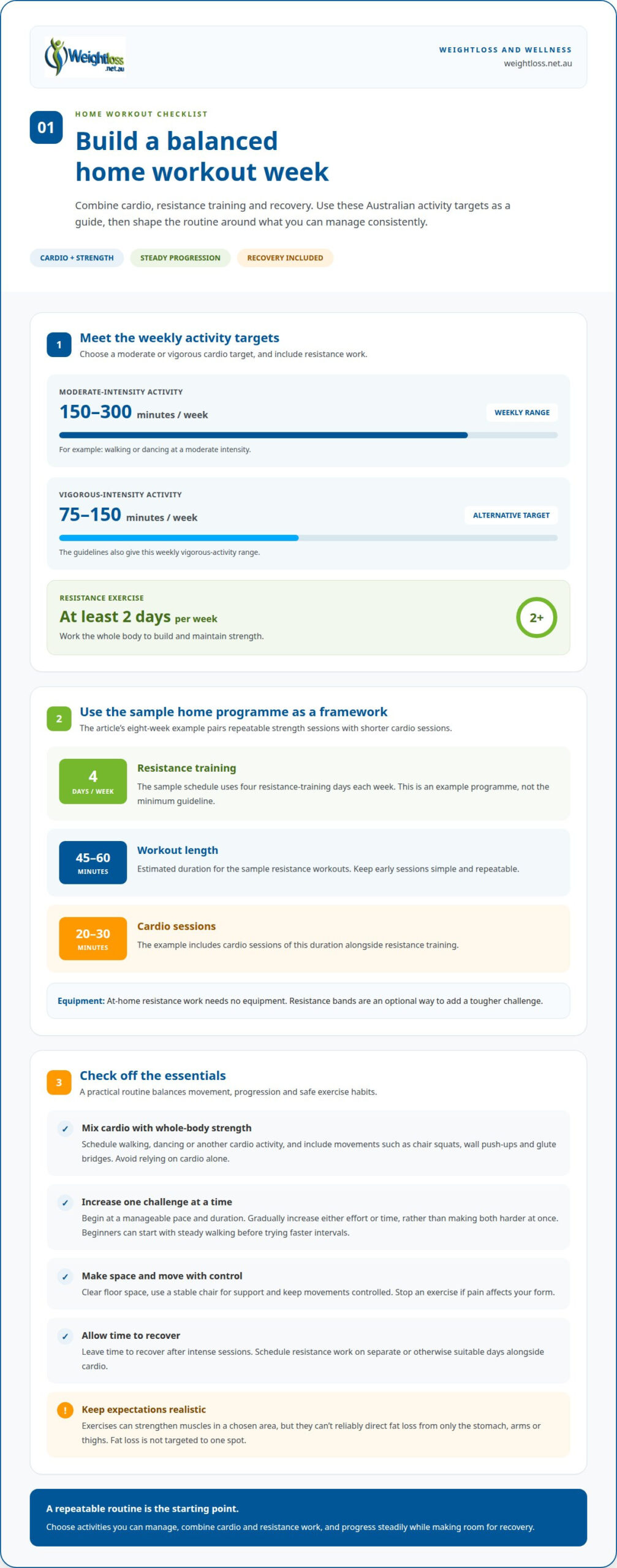
Build a week around walking, dancing or another cardio activity, then schedule resistance sessions on separate or suitable days. Australian guidelines recommend 150-300 minutes of moderate-intensity activity or 75-150 minutes of vigorous-intensity activity per week. The Australian Government Department of Health and Aged Care recommends resistance exercise on at least 2 days per week. Avoid relying on cardio alone.
-
Progress intensity and duration safely
Start at a pace and duration you can manage while keeping your movements controlled. Increase either the effort or the time gradually, rather than making both harder at once. Beginners can start with steady walking before trying faster intervals. If weight is a specific health concern, speak with a doctor before starting a cardio and strength routine.
- Use resistance exercises for your whole body, such as chair squats, wall push-ups and glute bridges. They strengthen muscles, but they can’t make fat come off only your stomach, arms or thighs: spot reduction isn’t how fat loss works. Regular resistance training can support blood pressure, blood sugar and cholesterol management, as well as posture, balance and mobility.
For an eight-week home programme, keep the first sessions simple and repeatable. A sample schedule uses resistance training on 4 days per week, with workouts estimated at 45-60 minutes and cardio sessions of 20-30 minutes. At-home resistance work needs no equipment; resistance bands can add a tougher challenge.
- Reduce injury risks by clearing floor space, choosing a stable chair for support and moving with control. Stop an exercise if pain affects your form, and allow time to recover after intense sessions. For a free Australian planning reference, use the Australian Physical Activity Guidelines to compare recommendations for moderate and vigorous activity with your routine.
Calorie intake and weight-loss nutrition
- Estimate your daily energy needs, then use the result as a planning guide. Basal metabolic rate, or BMR, estimates energy used at rest; total daily energy expenditure, or TDEE, also accounts for activity. One example gives a BMR of 1,417 calories per day and a TDEE of 2,196.35 calories per day after multiplying by the moderate activity factor of 1.55.
- Set a manageable calorie target rather than cutting food sharply. The programme’s method subtracts 500 calories from the calculated daily requirement. Treat this as a starting calculation, not a reason to ignore hunger, energy or training recovery. Your activity level affects estimated needs: the listed factors are 1.2 for sedentary, 1.375 for light activity, 1.55 for moderate activity and 1.725 for very active activity.
- Build meals around protein-rich foods, vegetables, fruit and satisfying high-fibre choices. Protein helps support muscle during weight loss, while resistance exercise gives muscles a reason to stay strong. The programme reports that around 20% of weight lost can be muscle mass. It also describes 40% more fat mass lost in a higher-protein plan with three resistance sessions weekly, compared with a high-carbohydrate diet without exercise. Those figures are not a personal forecast.
- Track patterns, not just a single meal or weigh-in. Note what you eat, your training and how your energy feels, then adjust portions and food choices consistently. The 3,500-calorie-per-pound figure is a simplified estimate, not a promise of a precise weekly change. If you’re following medical weight-loss support, align food choices with that plan. For practical weight-loss support resources, explore guidance and tools suited to your routine.
Exercise sets, repetitions and rest periods
- Choose a clear set-and-repetition target before starting each movement. A set is one group of repetitions, while repetitions are the individual movements within it. In Upper Body Workout A, each listed exercise uses 2 sets of 10 repetitions. Use that structure to organise the work, and focus on controlled movement rather than rushing through the count. If your form changes, pause and reset.
- Follow the rest instruction attached to the exercise instead of treating every break alike. Upper Body Workout A prescribes a 45-second rest after dumbbell pullovers. Use the pause to regain control and prepare for the next set. Rest periods are part of the session, not wasted time; starting again before you can move steadily may make it harder to maintain good technique.
- Keep track of the exact prescription for each exercise, because targets can differ within a programme. Upper Body Workout B prescribes 2 sets of 20 repetitions for bent-over dumbbell rows. Workout #3 uses a plank held for 30 seconds across 2 sets. Record your completed sets, repetitions or hold time, then compare the next session with that record rather than guessing.
- Use a repeatable circuit when the programme gives one, and leave room for recovery afterwards. The Weightloss and Wellness exercise plan repeats a set of four exercises 3-4 times. Move through the sequence in order, keeping each repetition controlled and resting when needed to maintain form. After intense exercise, allow your body time to recover and repair muscle before asking it to work hard again.
What home exercises are most effective for weight loss?
- Choose movements that work several muscle groups and can be repeated with controlled form. Chair squats train the legs and hips; wall push-ups work the chest, shoulders and arms. Glute bridges add a floor-based option for the hips and back of the legs. These exercises need little space, and you can adjust each by changing your range of movement.
- Pair strength movements with a cardio activity you’ll keep doing. Brisk walking, dancing at home or stepping in place can raise your breathing rate without specialist equipment. Keep the effort manageable enough to maintain steady movement. For a simple circuit, alternate a squat, a wall push-up and a short spell of marching on the spot.
- Build variety into your routine instead of repeating one exercise for every body part. Try bent-over rows for the back, a plank for the trunk and chair squats for the lower body. The exercise examples in this plan include rows and a 30-second plank. Choose versions that let you move steadily, and pause if your form becomes difficult to control.
- Make the movements fit your space and current ability, then record which options feel manageable. A sturdy chair can support sit-to-stands, while a clear patch of floor suits glute bridges or planks. If you want to add resistance, explore exercise products that suit home training. Choose practical equipment that supports movements you can perform with control, rather than adding complexity for its own sake.
Weightloss and Wellness: Affiliate Products from Amazon, Walmart and others
Weightloss and Wellness shares informational content about healthy eating, exercise and wellness, along with helpful videos and eBooks. The site also includes affiliate links to products from external retailers. A wearable may help you track activity, while suitable workout clothing can make home exercise more comfortable. The site’s content does not constitute product endorsement.
When choosing products to support home exercise or everyday nutrition, consider what fits your habits and makes your plan easier to follow. A product can’t replace consistent movement and balanced meals. Weightloss and Wellness provides articles, videos and eBooks to help you plan sustainable lifestyle changes.
For a practical next step, visit weightloss.net.au to explore the site’s articles, videos and eBooks.
Make your next step one you can maintain
Choose a routine that fits your real week, not an ideal version of it. A home workout plan for weight loss is more useful when it allows for busy days, changing energy and gradual progress. Make it easier to return to exercise by setting out your shoes, choosing a regular time or keeping a simple record of completed sessions.
Review your routine as you go. If a movement feels uncomfortable or your schedule keeps getting in the way, adapt the plan rather than abandoning it. Small adjustments can make training more practical and help you build a habit that supports your broader wellbeing. Your next step can be finding products that suit the way you prefer to exercise and eat.
Contact Weightloss and Wellness to explore options for your health and fitness journey. Keep your focus on steady effort, and give yourself space to build a routine that lasts.
Frequently Asked Questions
Can you spot-reduce body fat?
No. Exercises can strengthen particular muscles, but they can’t make your body lose fat from only that area. For example, repeated crunches train your abdominal muscles, but they don’t control where fat loss occurs. Instead, work different muscle groups and focus on habits you can sustain. This keeps your training balanced without relying on promises of targeted fat loss.
Who is it for?
This approach suits people who want to exercise at home and build fitness through repeatable movements. Beginners can try chair squats, wall push-ups and walking, adjusting each activity to their ability. If weight is a specific health concern, speak with a doctor before starting. This information is for reference only, not medical advice, and does not constitute product endorsement. Consult a doctor before changing your diet or beginning a weight-loss programme. This page contains affiliate links, and a commission may be earned at no extra cost to you.
What is a beginner-friendly weekly home workout plan for weight loss?
Try strength sessions on Monday and Thursday, with comfortable walks on Tuesday and Saturday. Use Wednesday and Sunday for rest or gentle movement, then decide whether Friday suits another walk. During strength sessions, practise chair squats, wall push-ups and glute bridges, keeping your movements controlled. This simple weekly pattern gives you clear training days while leaving room to adjust around work, family or recovery.
How many minutes of exercise per week are recommended for weight loss in Australia?
The Australian Physical Activity Guidelines recommend 150-300 minutes of moderate-intensity activity per week, or 75-150 minutes of vigorous-intensity activity per week. The Australian Government Department of Health and Aged Care also recommends resistance exercise on at least 2 days per week. These are activity recommendations, not a guaranteed weight-loss amount. Brisk walking is one way to accumulate moderate activity across your week.
How should cardio and strength training be combined for fat loss?
Include both across your week, placing them on separate days or combining them when that suits your schedule. For example, do a strength session before a walk, or walk between resistance workouts. Choose a pace that lets you maintain control during each activity, and allow time to recover after demanding sessions. A repeatable schedule is more useful than trying to make every workout intense.
Can you lose weight with home workouts without equipment?
Yes. You can do bodyweight exercises at home without equipment. Chair squats, wall push-ups, glute bridges and planks use your body and available floor space. To make an exercise more challenging, slow the movement or choose a more demanding variation while keeping your form steady. A clear area and a stable chair can help you organise a practical routine without buying workout gear.