
Could the supplement promising the fastest weight loss be the least suitable choice for your plan? It’s understandable to want clear answers when claims conflict and labels are difficult to compare. Medical weight loss support supplements may have a limited, supportive role, but they aren’t a substitute for evidence-based care or a guarantee of results. The right question isn’t which product makes the boldest promise, but whether it fits your health needs and clinician-guided plan.
This practical Australian buying guide explains how to compare supplement categories, assess claims and read labels. It also covers how products may be regulated, what safety considerations and medicine interactions to keep in mind, and what to discuss with your treating clinician or pharmacist. Use these steps to make an informed choice without feeling pressured by marketing.
Key Takeaways
- Match a supplement’s intended role to a clear need in your weight management plan, rather than choosing by its headline promise.
- Compare medical weight loss support supplements by evidence, ingredients and suitability. Distinguish general wellbeing claims from claims of direct fat loss.
- Read the label to understand a product’s ingredients and intended use, then discuss possible interactions or health considerations with your clinician or pharmacist.
- In Australia, understand what TGA regulation and ARTG listing can tell you, and why regulatory status isn’t a promise of results.
- Use a simple decision process to compare product categories and consider whether a product fits your clinician-guided care.
What medical weight loss support supplements can, and cannot, do
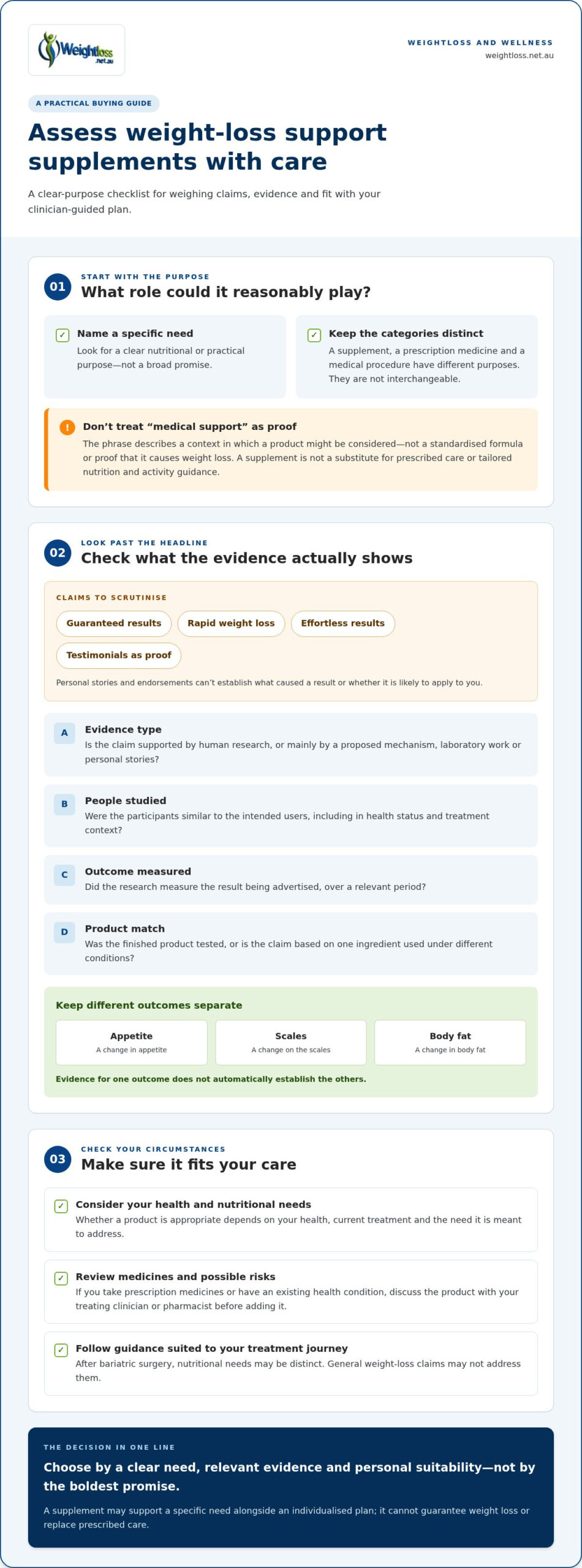
Supplement claims can be confusing, particularly when you’re already receiving medical care and working out what belongs in your plan. A product described as “medical weight loss support” may sound like a treatment in its own right. In practice, the phrase describes the context in which a product might be considered, not a standardised formula or proof that it causes weight loss.
“A support supplement is a product that may help address a specific nutritional or practical need alongside an individualised weight management plan; it isn’t a treatment for a medical condition or a substitute for prescribed care.” This distinction helps keep expectations grounded. Medical weight loss support supplements can’t guarantee weight loss, replace prescribed medicines or take the place of nutrition and activity guidance tailored to you.
What does “medical weight loss support” mean?
The phrase can describe different kinds of products. Some nutritional products are intended to help meet dietary needs. Prescription medicines are treatments used under a clinician’s direction, while medical procedures are separate interventions. These categories aren’t interchangeable, even if marketing language groups them together.
Whether a supplement is appropriate depends on your health, current treatment and nutritional needs. A product intended to help meet a dietary need, for example, has a different purpose from a medicine prescribed to manage a condition. The label alone can’t tell you whether a product suits your circumstances.
Why supplements are only one part of a broader plan
Weight management plans can bring together food choices, movement, sleep and clinical care, with the right mix shaped around the individual. A supplement may be considered for a particular reason, but it can’t provide that broader structure or reliably deliver lasting weight loss on its own.
Your treating clinician can help assess whether there’s a nutritional need to address, whether a product fits alongside your treatment and whether it could pose risks for you. This is especially relevant if you take prescription medicines or have an existing health condition. A pharmacist can also help review how a product may fit with your medicines.
Before considering a product, frame the decision around its purpose rather than its promise:
- What need is it intended to support? Look for a clear, specific purpose rather than a broad claim.
- How does it fit my care? Consider whether it complements, rather than replaces, your clinician-guided plan.
- Is it suitable for me? Discuss your health, nutritional needs and medicines with a clinician or pharmacist.
This doesn’t mean every supplement is unsuitable. It means starting with your needs and the role a product could reasonably play, not a headline promising a quick result. For individuals looking into targeted wellness support tailored to their routine, Zenutri Personalised Vitamins provides helpful guidance on ingredient roles and custom formulations.
How to assess supplement evidence and realistic support roles
A confident claim isn’t the same as convincing evidence. To judge whether a supplement may be useful, look beyond its headline and ask what was studied, in whom and what outcome was measured. A change in appetite, a change on the scales and a change in body fat are different outcomes. Evidence for one doesn’t automatically establish the others.
A plausible explanation for how an ingredient might work doesn’t prove it will produce meaningful weight loss in people. Research on a single ingredient also can’t establish that every finished product containing it has the same effect. Formulation, amount, quality and the people studied can all differ. Treat broad claims cautiously unless the evidence relates to the actual product and its intended users.
Which claims deserve careful scrutiny?
Promises of guaranteed, rapid or effortless weight loss are warning signs, not proof. Testimonials and influencer endorsements may describe someone’s experience, but they can’t show what caused the result or whether it’s likely to apply to you. Look for claims that explain their evidence rather than relying on dramatic before-and-after stories.
When reviewing a claim, consider:
- Evidence type: Is the claim supported by human research, or mainly by a proposed mechanism, laboratory work or personal stories?
- Relevant participants: Were the people studied similar to the intended users, including in health status and treatment context?
- Measured outcome: Did the research assess the result being advertised, and over a relevant period?
- Product match: Was the finished product tested, or is the claim based on one ingredient used under different conditions?
Separate nutritional adequacy or general wellbeing claims from direct fat-loss claims. A product may be intended to help address a particular nutritional need without evidence that it causes weight loss. These are different purposes, and a label’s wording shouldn’t blur them.
How supplements may fit different treatment journeys
Supplement use isn’t a universal requirement. Nutritional support may be worth considering if there’s a specific need, but the reason should make sense for your health and care plan. If you use prescribed weight management medicines, discuss any supplement with your treating clinician or pharmacist before adding it. They can consider your medicines, health conditions and potential risks together.
People who have had bariatric surgery may have distinct nutritional needs. Rather than relying on general weight-loss claims, follow guidance suited to that treatment journey, such as this post-op weight loss vitamin guide.
Once you have a clear purpose in mind, compare product information with that need rather than chasing the strongest promise. For product discovery, explore medical weight loss support products, then consider any purchase in the context of your clinician-guided plan. Product information isn’t personalised medical advice.
Compare medical weight loss support supplement categories by purpose
Different products serve different purposes, so there isn’t one category that’s best for everyone. Start by identifying the need a product is meant to address. Then consider the evidence, label details and whether it suits your treatment plan. The descriptions below are general, not recommendations for an individual.
| Category | Intended support role | Evidence caveat | Key safety question |
|---|---|---|---|
| Protein products | May provide a convenient source of protein as part of a person’s overall eating pattern. | Being a source of protein doesn’t establish that a product causes weight loss or is needed by everyone. | Does the serving suit my dietary needs and fit with my overall nutrition plan? |
| Fibre products | May add fibre to the diet where that is appropriate for the individual. | The presence of fibre alone doesn’t prove a product will lead to fat loss or deliver a particular result. | Is this suitable for me, considering my health, medicines and how I’ll use it? |
| Meal-replacement products | May offer a structured food option in a plan where this approach is appropriate. | A product’s intended use and nutritional profile matter; marketing alone doesn’t show it is suitable or effective for you. | Does it fit the plan and guidance I’ve received, and can I use it as directed? |
| General wellness supplements | May be used to support a specific nutritional or general wellbeing need. | A broad wellness claim isn’t evidence of direct weight-loss effects. | Is there a clear reason for taking it, and could it interact with my medicines? |
Protein, fibre and meal-replacement products
For these categories, compare the serving information and full ingredient list, then consider how the product fits your dietary needs and clinician-guided plan. A meal-replacement product, for example, isn’t automatically appropriate just because it offers a defined serving. If you’re exploring options beyond weight management, this guide to wellness products in Australia offers broader product discovery.
People who have had bariatric surgery may have specific nutritional requirements. Keep supplement decisions tied to their post-operative care guidance rather than assuming general products are interchangeable with products intended for that context.
“Metabolism” and multi-ingredient supplements
Words such as “metabolism support” describe a marketing angle, not proof of a clinically meaningful weight-management effect. Look for the complete ingredient list and the quantity of each ingredient. If amounts are unclear or several ingredients are combined, it can be harder to assess what the product is intended to do and whether it suits you.
Take extra care with stimulant-containing products or blends if you take medicines or have a health condition. Don’t assume that combining familiar ingredients makes a product safe for your circumstances. A clinician or pharmacist can help review the label in light of your health and treatment.
Compare medical weight loss support supplements by purpose and personal fit, not as universally better or worse options. To browse categories, explore weight management support products as a starting point for product discovery, then consider any option alongside your clinical guidance.
Use this Australian checklist to assess safety and product labels
A label can help you understand what a product contains, but it can’t tell you on its own whether it’s right for your health or treatment. Use this checklist to slow down the decision and identify questions to raise with a clinician or pharmacist.
- Identify the intended use. Pinpoint the specific need the product claims to support. A broad promise to help with weight loss is less informative than a clearly described purpose.
- Inspect the ingredients. Read the full ingredient list and the amount of each active ingredient per serve. If quantities or ingredients in a blend aren’t clear, it may be difficult to assess what you’d be taking.
- Check the claims. Compare the wording on the label with the product’s intended use. Claims of guaranteed or rapid results aren’t proof of effectiveness.
- Assess personal suitability. Consider your medicines, health conditions and nutritional needs, then seek individual advice if anything is uncertain.
What to check on an Australian supplement label
Look for directions for use, warnings, active ingredients and amounts per serve, along with details identifying the responsible supplier. Read the whole label, not just the front panel. Keep the packaging or take a clear photo so a pharmacist or clinician can review the same information you’re considering. For a broader look at how to assess sugar free diet products, remember that a front-of-pack claim is only one part of the full nutrition picture.
In Australia, products can fall into different regulatory categories. Some products sold as supplements are regulated as foods, while therapeutic goods are regulated by the Therapeutic Goods Administration (TGA). Therapeutic goods generally need to be included in the Australian Register of Therapeutic Goods (ARTG) before they can be lawfully supplied, subject to applicable exemptions. Check the product’s category and claims rather than assuming every item described as a supplement follows the same pathway.
For listed medicines, ARTG inclusion reflects a regulatory status and pathway; it isn’t a guarantee of weight-loss effectiveness or proof that the medicine is suitable for you. Listing and registration involve different requirements, so don’t treat an ARTG entry as a personal recommendation or promise of results.
When to seek personalised advice before using a supplement
Speak with your treating clinician or pharmacist before adding a product if you take prescription medicines or manage an ongoing health condition. Individual advice is also important during pregnancy or breastfeeding, and before planned surgery. These situations can change what’s appropriate, so don’t rely on general marketing claims or another person’s experience.
Before use, check the complete label and discuss possible interactions with a qualified health professional if you take medicines or have a health concern. Don’t start, stop or change prescribed treatment because of a supplement label. Medical weight loss support supplements should be considered within your care plan, not used to replace it.
Once you know what you’re looking for, compare weight management support products as a product-discovery step, then use the label and your clinician-guided plan to inform your decision.
Choose support products thoughtfully and take the next step
Choosing a product doesn’t mean choosing the most popular option or the one with the strongest claim. Work through a few practical questions instead: what need are you addressing, what supports the product’s claims, and does it fit your health and clinician-guided plan? This keeps the focus on suitability rather than pressure to buy.
A simple decision framework before adding a product
Before considering medical weight loss support supplements, use this sequence to keep your decision grounded:
- Identify the need. What specific purpose would the product serve, and has that need been assessed as relevant to you?
- Review evidence and ingredients. Look for information that relates to the product and its intended use. Read the ingredient list and amounts before weighing up convenience or format.
- Check safety and clarity. Can you understand the label, directions and warnings? If you take medicines or have a health concern, raise potential risks with your clinician or pharmacist.
- Pause if something doesn’t add up. Absolute claims, unclear ingredient information or unresolved safety questions are reasons to hold off and seek advice.
Only after addressing those questions should practical preferences, such as taste, format or ease of use, come into the comparison. A product that suits someone else may not suit your needs, and appearing in a product category doesn’t make it the right choice for every reader.
Explore products as part of a considered plan
Weightloss and Wellness is an Australian affiliate product-discovery marketplace featuring health, wellness and supplement products from external retailers. Its product comparisons can help you explore categories and product information, but they aren’t personalised health advice or a substitute for guidance from your treating clinician. Your decision should reflect your circumstances and care plan.
Affiliate disclosure: Some links to products or retailers may be affiliate links. If you make a purchase through them, Weightloss and Wellness may earn a commission. This referral relationship doesn’t establish that a product is suitable for you or guarantee an outcome, so use the information as a starting point for informed comparison.
If you’re ready to browse, explore health and wellness products with your intended purpose and clinical guidance in mind. Compare the information and choose only if a product makes sense for your plan.
Make your next step a considered one
Your next step doesn’t have to be buying a product. You might first note a specific need, then discuss it with your treating clinician or pharmacist to see whether a supplement belongs in your plan. That pause can help you choose with more confidence and avoid letting persuasive marketing set the direction of your care.
Weightloss and Wellness is an Australian-focused affiliate marketplace for health and wellness product discovery, with categories including supplements and products that support medical weight management. Use its product information to compare options, while remembering that browsing is educational, not personalised medical advice. Any decision about medical weight loss support supplements should reflect your needs and clinical guidance.
Explore health and wellness products at your own pace, keeping your wellbeing at the centre of each choice. A thoughtful plan is built one sensible step at a time.
Frequently Asked Questions
Do medical weight loss support supplements actually work?
Some products may help address a particular nutritional or practical need, but you shouldn’t assume they cause weight loss. Evidence for an ingredient doesn’t automatically apply to every product containing it. Research on one formulation, for example, may not tell you whether a different product, dose or combination has the same effect. Look for evidence relevant to the finished product and the outcome it claims to support, and keep expectations realistic.
Can I take supplements while using prescription weight loss medication?
Possibly, but get advice from your prescriber or pharmacist before combining them. Bring the product packaging or a photo of the full label, including amounts per serve, and tell them about other medicines and supplements you use. This helps them check for potential interactions or overlapping ingredients. Don’t reduce, stop or change a prescribed medicine because a supplement appears to offer a similar benefit.
Are weight loss supplements regulated in Australia?
Yes, but the regulatory pathway depends on how a product is classified. Some products sold as supplements are regulated as foods; therapeutic goods are regulated by the TGA and generally need to be included in the Australian Register of Therapeutic Goods (ARTG), subject to applicable exemptions. Therapeutic goods and foods have different rules for claims. A product’s category and regulatory status don’t, by themselves, show it will deliver weight loss for you.
What should I look for on a weight loss supplement label?
Check the full ingredient list, amount of each active ingredient per serve, directions, warnings and supplier details. Compare the stated serve with how you’d actually use the product. Look for allergens or ingredients you’ve been advised to avoid, and check the expiry date before use. If a blend doesn’t disclose ingredient amounts, or the directions and claims are hard to interpret, pause and ask a pharmacist to review it.
Are metabolism-boosting supplements safe to use?
Not necessarily. “Metabolism-boosting” is a marketing phrase, not a safety assessment, and products can contain different ingredients and quantities. Be particularly cautious with stimulant-containing products or multi-ingredient blends if you have a health condition or take medicines. Don’t rely on online testimonials to judge safety. Show the full ingredient list to a pharmacist or clinician before use, especially if you’re unsure what an ingredient is or how it may affect you.
Do I need supplements during medical weight loss?
No, supplements aren’t automatically needed by everyone following a medical weight management plan. Whether one is appropriate depends on your diet, health and treatment needs. Rather than starting a product “just in case”, discuss concerns about your nutrition with your treating clinician, who can advise whether further assessment or targeted support is appropriate. This keeps product choices purposeful and avoids adding something that doesn’t meet a clear need.