What if your sleep score were a clue, not a verdict? Sleep tracking devices for wellness can help you notice patterns, but a nightly score or stage estimate isn’t a complete picture of how well you’ve rested.
If you’ve wondered why two devices report different results, or felt pressure to achieve a “perfect” night, you’re not alone. Trackers estimate sleep from signals they can measure. Their readings are generally more useful for spotting broad trends than confirming exactly how long you spent in each sleep stage. Keeping that distinction in mind can make the data less confusing and help put tracking in perspective.
This guide explains common sleep metrics, how trackers estimate them and how their insights may support realistic wellbeing habits. You’ll also learn why device results can vary, how to use trends without letting a score shape your whole day, and when sleep concerns call for professional advice rather than another night of tracking.
Key Takeaways
- Sleep tracking devices for wellness can help you explore routines and consistency, but their readings are estimates rather than definitive measurements.
- Learn which signals different devices may use and why results can vary between trackers.
- Use repeated patterns to guide reflection, not to assume a sleep metric proves the cause of how you feel or perform.
- Try a simple routine: choose one question, track consistently, review trends and test one manageable change.
- Compare wearable tracking, a sleep diary and no tracking to find an approach that supports your wellbeing without adding pressure.
Why sleep tracking devices for wellness are gaining attention
Sleep tracking devices estimate sleep-related patterns, usually from movement and, on some devices, signals such as heart rate. They can turn a night into an accessible summary of likely sleep and wake periods, but they don’t directly observe what’s happening in the brain. Sleep tracking estimates patterns; it doesn’t provide a direct view of sleep.
That estimate can still prompt useful questions. Are your bedtimes fairly consistent? Do you tend to wake during the night? Do you feel rested in the morning? As people use wearables and other tools to keep an eye on different aspects of wellbeing, sleep data can offer another perspective on everyday routines. Its value is in informed curiosity, not pressure to chase a perfect score or a quick fix for health goals.
Consumer tracking is different from a clinical sleep assessment. A wearable can provide personal estimates and trends, but it can’t diagnose a sleep disorder or replace a clinical assessment. The Sleep tracking devices overview explains common approaches and limitations. For sleep tracking devices for wellness, treat the data as one piece of context alongside how you feel and function.
What do people hope to learn from tracking sleep?
Often, it’s something practical: whether bedtime shifts from night to night, whether wake-ups seem to recur, or whether a steadier routine feels different the next day. People may be curious about recovery, too, but a tracker can’t establish why they feel more or less rested. One night is a snapshot, not evidence of a lasting pattern.
Why a sleep score is not the whole picture
A sleep score compresses several estimates into one convenient number. That makes it easy to scan, but the score may conceal which inputs influenced it and how uncertain the estimates are. A high score doesn’t prove you’re in good health, just as a low score isn’t a diagnosis. Compare the device’s summaries with your experience of rest and daytime functioning. Look for patterns over time instead of letting one fluctuating score set the tone for your day.
Sleep data also shouldn’t be treated as proof that sleep caused a change in weight, energy or performance. It may help you notice routines worth reflecting on, but it can’t explain every outcome. Ask yourself whether tracking helps you understand your habits or adds worry. If the numbers create pressure, stepping back is a reasonable part of a balanced wellness approach.
How sleep tracking devices estimate sleep and nightly patterns
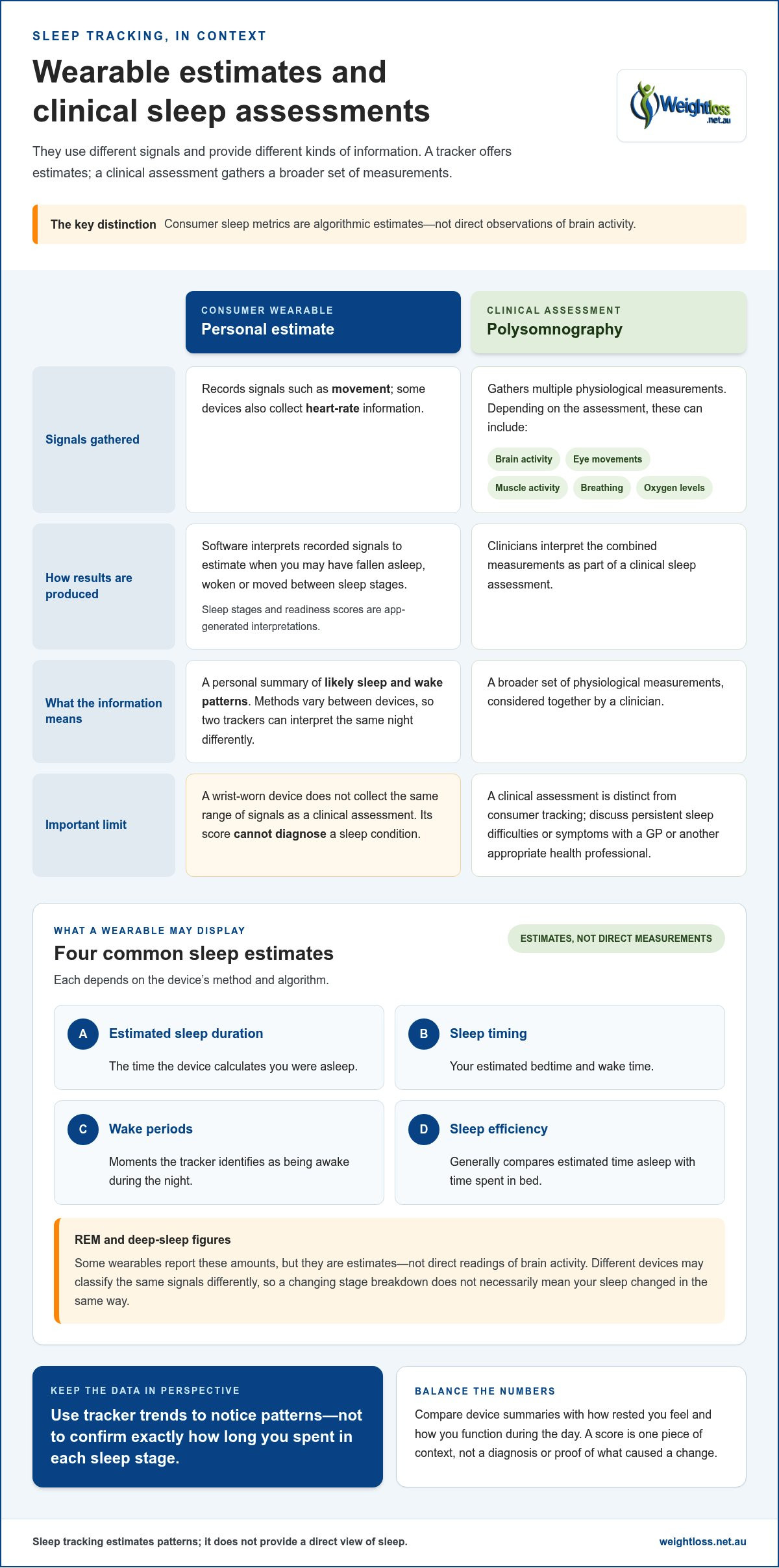
Most wearables don’t measure sleep directly. They record signals such as movement, and some also collect heart-rate information. Software uses these inputs to estimate when you may have fallen asleep, woken or moved between sleep stages. Sensors and methods vary between devices, so two trackers can interpret the same night differently.
Consumer sleep metrics are algorithmic estimates, not direct observations of brain activity. The movement-based approach is known as actigraphy: a device records activity and inactivity over time, then uses those patterns to estimate sleep and wake periods. A tracker may directly record movement or heart-rate signals, but sleep stages and readiness scores are app-generated interpretations. This distinction matters when deciding how much weight to give the numbers from sleep tracking devices for wellness.
Which sleep metrics might a wearable show?
Estimated sleep duration is the time the device calculates you were asleep. Sleep timing refers to your estimated bedtime and wake time. Wake periods are moments the tracker identifies as being awake during the night, while sleep efficiency generally compares estimated time asleep with time spent in bed. These labels are useful, but each depends on the device’s method and algorithm.
Some wearables also report REM and deep-sleep amounts. Those figures are estimates, not direct readings of brain activity, and different devices may classify the same signals differently. A changing stage breakdown doesn’t necessarily mean your sleep changed in the same way.
Wearable estimates versus a sleep study
A clinical sleep assessment called polysomnography gathers multiple physiological measurements. Depending on the assessment, these can include brain activity, eye movements, muscle activity, breathing and oxygen levels. Clinicians interpret the combined information. A wrist-worn device doesn’t collect the same range of signals or provide an equivalent assessment.
For a plain-language discussion of the accuracy of sleep tracking devices, Johns Hopkins Medicine explains what consumer trackers can and can’t tell you. Their data may help you notice patterns, but a score cannot diagnose a sleep condition. If sleep difficulties or symptoms persist, discuss them with your GP or another appropriate health professional rather than relying on an app’s interpretation.
Wearable health technology can be one option in a broader wellbeing routine. Explore wearable health technology while keeping your own experience and sustainable habits in view.
What sleep tracking data can tell you, and where it can mislead
A tracker can help you notice repeated patterns, such as a bedtime that shifts later across the week or regular periods when you appear to wake. These observations may prompt you to reflect on your routine. They don’t establish why a pattern occurs or prove that it caused a change in your health, weight or daytime performance.
More detailed charts aren’t automatically more accurate. Algorithms interpret signals, and estimates can be affected by device type, how well a wearable fits and individual differences. Treat sleep tracking devices for wellness as one source of information, alongside your own sense of rest and how you function during the day.
| Metric | What it may suggest | What it cannot establish |
|---|---|---|
| Sleep timing | Whether your estimated bedtime and wake time follow a recurring pattern. | Why your schedule varies or whether a particular timing is right for you. |
| Estimated sleep duration | How long the device thinks you slept. | Your exact sleep time or whether you feel restored. |
| Wake periods | Possible interruptions or changes in movement overnight. | The cause of an awakening, or whether every brief wake-up was detected. |
| Sleep stages | An algorithm’s estimate of time in REM, light or deep sleep. | A direct measurement of brain activity or a diagnosis. |
| Sleep score | A summary of selected estimates according to that device’s system. | A complete measure of sleep quality, health or readiness for the day. |
Can a tracker reliably identify sleep stages?
Sleep-stage labels are estimates, not direct readings of brain-wave activity. Devices use different sensors and algorithms, so comparing stage charts across brands can be like comparing two scoring systems rather than identical measurements. Focus on whether a broad pattern repeats on the same device, and don’t treat a single stage result as definitive.
When tracking becomes stressful instead of helpful
Checking scores repeatedly or feeling you must earn a high number can turn a wellbeing tool into a source of pressure. You may come across the term orthosomnia in discussions about anxiety linked to trying to achieve “perfect” tracker data. It isn’t a label to apply to yourself based on an app result.
If tracking makes you more worried, pausing it is a reasonable choice. Return to simple observations, such as your routine and how you feel during the day. If sleep concerns persist or affect daily life, speak with an appropriate health professional rather than relying on a score to explain them.
How to use sleep tracking devices for wellness without chasing perfect data
A tracker is most useful when it helps answer a small, practical question. Rather than trying to improve every metric, decide what you’re curious about, such as whether your bedtimes vary across the week. Use the information as a prompt to reflect, not a performance target.
A simple routine for reviewing your sleep data
Keep the process steady and low-pressure. This four-step routine can help turn estimates into manageable wellbeing habits:
- Choose one question. For example, do your bedtimes tend to shift later on certain nights?
- Track consistently. Use the same device and usual settings where practical, so you’re comparing like with like. Add a brief note of your bedtime, wake time and how rested you feel. There’s no need to record every detail.
- Review at a planned interval. Choose a regular time to look over the pattern, rather than checking the app repeatedly overnight or first thing each morning. An isolated result can be affected by an unusual night or an imperfect estimate.
- Test one manageable adjustment. If the pattern suggests your schedule varies, you might try a steadier bedtime routine. Change one thing at a time, then notice whether it feels helpful instead of expecting the score to confirm success.
Sleep tracking devices for wellness can offer a useful record, but the aim is understanding, not perfect data. Treat tracker data as a prompt for reflection, not a performance target. Compare patterns over time with how you feel and function during the day. If a change doesn’t suit you, it’s fine to reconsider it.
Protect privacy and keep tracking sustainable
Sleep records can feel personal, so review the app’s privacy settings and permissions. Look for information about what data it collects, how it’s stored and whether it may be shared. Settings and policies differ between apps, so focus on the choices available in the one you use.
Make the tool fit around your routine, rather than letting it set the pace. If alerts prompt worry or interrupt your evening, turn off non-essential notifications where you can. If tracking starts to feel stressful, taking a break or stopping altogether is a valid choice. Your wellbeing routine doesn’t need a device to count.
Wearable health technology can be one part of a broader wellness routine. Explore wearable health technology and consider what would genuinely support your goals.
Choosing a wellness approach that puts sleep, not the score, first
The right approach helps you understand your routine without adding pressure. Sleep tracking devices for wellness may suit people who value automatic records and are comfortable treating the results as estimates. But a wearable isn’t essential: a paper diary or simply paying attention to how you feel can also support thoughtful habits.
Is a wearable, sleep diary or no tracker the better fit?
Consider how much effort you want to spend and what kind of insight would be useful. A wearable may record patterns with little daily effort, while a diary gives you space to note routines and perceived rest in your own words. No tracking is a valid choice too. Helpful sleep habits don’t depend on owning a device.
| Approach | Effort and insight | Possible drawback |
|---|---|---|
| Wearable tracker | Usually records automatically and may summarise estimated sleep timing and duration. | Estimates may vary, and scores or notifications can become a source of pressure. |
| Basic sleep diary | Requires a brief note of bedtime, wake time and how rested you feel; keeps the focus on your own observations. | Relies on memory and takes a little time to update. |
| No tracking | Requires no device or record-keeping. You can focus on a steady routine and your daytime experience. | Offers less recorded detail for looking back at patterns. |
Ask yourself: is this method helping me make a realistic change, or encouraging me to judge each night? If tracking leads to useful reflection, keep it simple. If it makes you anxious or preoccupied, a diary, fewer notifications or no tracking may be a better fit. The numbers don’t need to be the centre of your wellbeing routine.
When to look beyond wellness tracking
Consumer devices can’t diagnose sleep disorders or replace a clinical assessment. If sleep difficulties persist, affect your daily life or come with symptoms that concern you, speak with an appropriate health professional. An app score shouldn’t delay that conversation or be treated as an explanation on its own.
For broader context, explore wellness resources alongside wearable health technology as one possible part of a sustainable routine. Start with a consistent, supportive sleep routine before adding more tracking. Choose the approach that helps you feel informed, not measured.
Let sleep data support your next small step
Sleep trackers can help you notice recurring patterns, but their scores and stage estimates aren’t definitive measures of how well you’ve slept. Use sleep tracking devices for wellness as a source of context: compare trends with how rested you feel, and remember that a wearable, diary or no tracking can each suit different people.
If you choose to track, keep the purpose simple. Look for patterns over time, try one manageable change and step back if the numbers start creating pressure. Persistent sleep concerns deserve attention beyond an app, and consumer data can’t replace professional advice.
Wellbeing isn’t built by chasing a perfect score. It grows through realistic routines and choices you can sustain. For broader wellness ideas and wearable health technology, explore wellness resources and wearable health technology from an Australian-focused marketplace. Explore the available wearable health technology and choose a next step that feels useful to you.
Frequently Asked Questions
Are sleep tracking devices accurate enough to improve wellness?
Sleep tracking devices for wellness can help you notice possible patterns, but their readings are estimates, not clinical measurements. Accuracy varies with the device, its sensors and algorithms, and individual differences such as movement during sleep. Tracking may prompt you to reflect on routines, but it can’t prove that your health has improved or explain why you feel rested. Use trends alongside your own experience, not as a verdict.
Can a sleep tracker detect sleep apnoea?
No consumer sleep tracker can diagnose sleep apnoea. Some devices may flag signals linked with breathing or oxygen levels, if they measure them, but those signals can’t confirm that you have the condition. If you’re concerned about symptoms such as disrupted sleep or significant daytime tiredness, speak with a health professional about an appropriate assessment. Don’t rely on an app result, whether reassuring or concerning, as a diagnosis.
What do sleep trackers measure while you are asleep?
Many wearables record movement, and some also use heart-rate signals. Their software interprets these inputs to estimate sleep duration, bedtime and wake time, periods of wakefulness and, on some devices, sleep stages. A tracker may also calculate a summary score from selected estimates. Sensors and methods differ, so check what your device actually records and treat its reported metrics as estimates rather than direct measurements of sleep.
Do sleep tracking devices accurately measure REM and deep sleep?
REM and deep-sleep figures from consumer trackers are estimates, not direct measurements of brain activity. Devices infer stages from signals they can record, and the sensors and algorithms used can vary. As a result, two devices may report different stage breakdowns for the same night. Treat one night’s figures as an indication from that tracker, not a definitive assessment of your sleep or a reason to make health decisions.
Can tracking sleep make sleep anxiety worse?
It can increase worry for some people, particularly if they check results often or feel pressure to achieve a high score. If the app is making you preoccupied with sleep, consider turning off alerts, checking less often or taking a break from tracking. A device-free routine is still a worthwhile option. If worry or distress persists, speak with a health professional for support rather than relying on tracker data.
Is a sleep tracker better than keeping a sleep diary?
Neither option is best for everyone. A wearable offers automatic estimates, while a diary lets you note routines, wake times and how rested you feel in your own words. A diary takes a little effort and relies on memory; a tracker can provide more data but may feel intrusive or stressful. Choose the approach that suits your goals and feels useful. You don’t need a device to build supportive sleep habits.
When should I speak to a health professional about sleep?
Seek professional guidance if sleep problems persist, noticeably affect your daytime functioning or involve symptoms that concern you. A wearable score can’t diagnose a sleep disorder, rule one out or replace a clinical assessment. It may help you describe patterns, but don’t wait for an app to confirm that a concern matters. Share what you’ve noticed with an appropriate health professional and discuss what support or assessment may be suitable.